Best Seats and Ticket Options at Utah Mammoth Games
Best Seats and Ticket Options at Utah Mammoth Games explains the best places to sit at Delta Center based on sightlines, atmosphere, amenities, and budget. Centre-ice lower bowl seats offer the best overall views, while upper-level sections provide excellent value for fans looking to experience Mammoth hockey at a lower price. This guide compares Utah Mammoth tickets, premium seating, club options, and complete travel packages with hotels for fans planning a game in Salt Lake City.
Best Seats and Ticket Options at Utah Mammoth Games
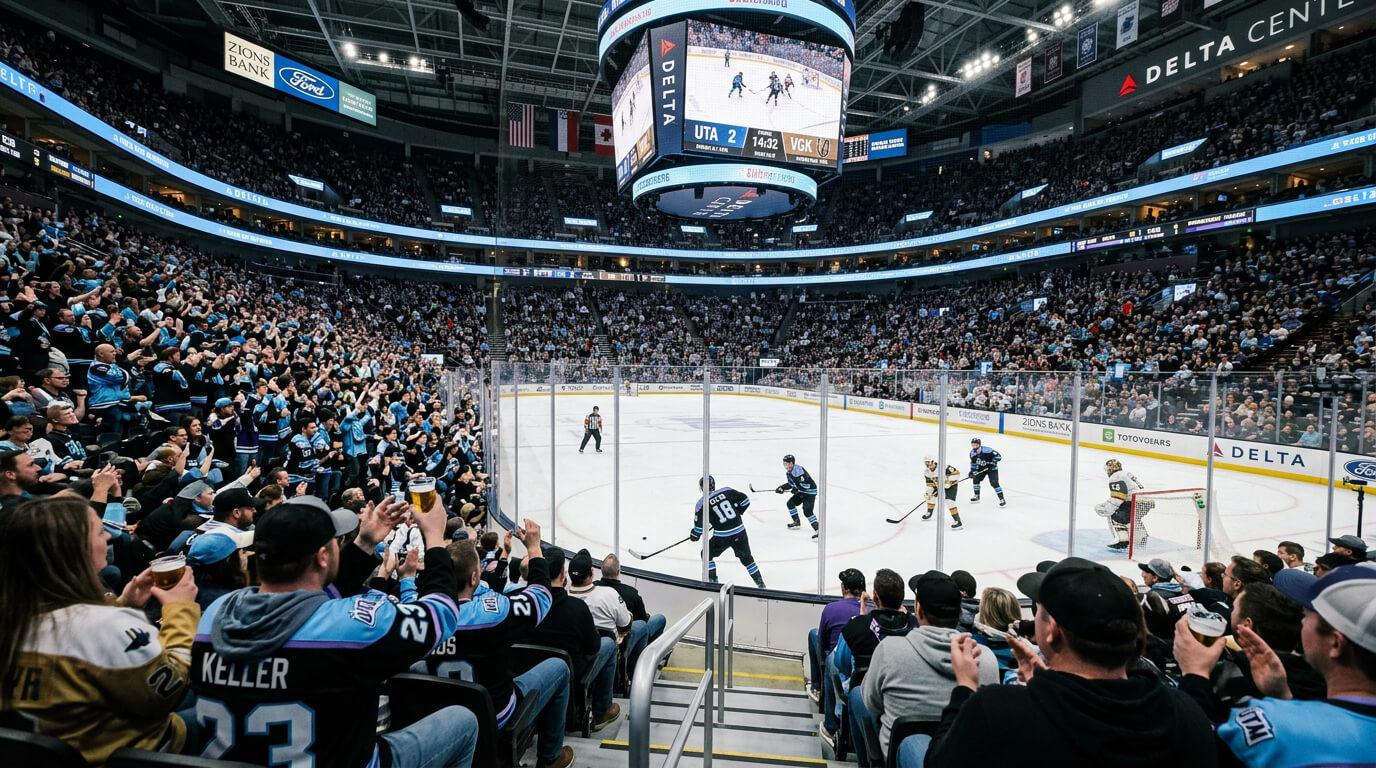
The arena runs an 18,175-hockey bowl (approximately 16,200 with unobstructed views) with the Utah Mammoth bench in front of 6 and 7, the visiting bench in front of 7 and 8 on the same sideline, and the penalty boxes on the opposite sideline directly across from the team benches. The Utah Mammoth shoot twice toward the goal in front of 12 and 13 in the first and third periods, and the visiting team shoots twice toward the opposite goal for those two periods - direction of play determines which end tickets deliver the offensive-zone action for each team. Peak atmosphere hits on a home goal, a snipe from the dot, or a stretch pass through the neutral zone against Colorado, Vegas, or the Kings. An extra thirty dollars can push you two rows closer to the ice in the lower level or into premium tickets along the attack blueline in front of the 8/17 pair - widely considered the best home views in the building. Bundling Utah Mammoth tickets with a downtown hotel steps from TRAX light rail through Utah Mammoth Travel Packages keeps the budget honest, and you're not overspending on a premium ticket because the rest of the trip got underbooked.
The arena opened in 1991 in downtown, ran as EnergySolutions Arena and Vivint Arena through the 2000s and 2010s, and took the current Delta Center name in 2023. The building sits at 301 South Temple, adjacent to the SPCC and within walking distance of Temple Square and the wider downtown corridor. The Utah Mammoth are the NHL's newest franchise - the team relocated from Arizona in April 2024, played the 2024-25 inaugural season as the Utah Hockey Club, and rebranded to the current Mammoth name for the 2025-26 season. Owner Smith Entertainment Group also operates the Utah Jazz (NBA), which shares the arena. The 2025-26 renovation added a revolutionary triple-scissor riser system built by StageRight that raised the floor two feet and gave every lower level seat a clear sightline for both hockey and basketball - a first-of-its-kind dual-sport transformation. The ticket market swings between softer weekday visits against Eastern opponents and Central Division weekend games against Colorado in the Rocky Mountain rivalry, Dallas, Minnesota, Nashville, Chicago, St. Louis, and Winnipeg, plus Pacific crossovers against Vegas, the Kings, Anaheim, and any Original Six visit from Toronto, Boston, Montreal, or Detroit. Row 1 puts you on the glass, but the aerial view that makes hockey readable disappears below row 6. Rows 8 through 14 in the same area give you the coach-eye view at lower prices. Repeat Utah Mammoth regulars run everything through Utah Mammoth Trip Packages instead of tabbing across five sites for a SLC weekend.
Row 1 behind the nets buys you the closest possible look at the puck, but the tall glass trims the far side of the play, and the video board becomes your primary tracking tool once the action swings to the opposite end. Mid-upper 200 sideline pairs run the opposite trade, priced below the lower level corners on non-marquee nights and delivering a full-ice view that the lower level end sections cannot match. Mid-upper sideline pairs above the 6-8 (bench side) and 15-16 (penalty box side) are the counterintuitive value pick at the venue, sitting directly above the coach-eye angle at a fraction of the premium spend. The 12/13 pair in the lower rows carry the loudest atmosphere in the building on a Colorado Saturday when the Rocky Mountain rivalry hits peak volume, and the crowd energy at the Utah Utah Mammoth attacking end carries into every corner around it.
Direction of Play at Delta Center: Which End Does the Home Team Shoot Toward?
Direction of play at Delta Center determines which end tickets are worth the buy for any given matchup, and this is the single most-asked question about the lower level layout on any hockey seating forum. The Utah Mammoth shoot twice toward the goal in front of 12 and 13 in the first and third periods, which puts offensive-zone action at that end for two of three periods on a home Utah Mammoth matchup. The 11-14 corner wraps the Utah Mammoth attacking end where the home top line drives the puck for two-thirds of the game, and 12 and 13 sit directly behind the goal camera. This is the loudest area in the building on a home goal, especially on a Colorado Avalanche Rocky Mountain night or any Vegas or Original Six visit.
The visiting team shoots twice toward the opposite goal in the first and third periods (approximately in front of 1 and 2), which is the exact opposite end from the Mammoth attacking direction. The corresponding wrap around the visitor attacking end covers the northeast side of the building - the 1-4 range on the lower level, plus the top tier the 101-106 and 138-140 corners that Smith Entertainment Group is renovating into multiple balconies of seating for the 2026 and 2027 summers. This end matters just as much depending on what you want to see - an Original Six visit from Toronto or Boston frequently draws travel fans who fill the visitor attacking area with their own colors, and a Colorado visit brings the burgundy-and-blue contingent to that end from the Rocky Mountain corridor. Sitting on the wrong end for an Avalanche Saturday is a real cost you can't fix once puck drops, since the marquee-night secondary market rarely opens up mid-game for a swap. Utah Mammoth Travel Packages built around a specific matchup route to the correct end based on which team you actually want to watch attack.
How to Read the Delta Center Seat Map
The lower level at Delta Center uses a single-digit numbering system for hockey - sections 1 through 20 wrap the ice on the newly-installed StageRight triple-scissor riser system that debuted for the 2025-26 season. The 6-8 cluster sits on the bench sideline with the Utah Mammoth bench in front of 6-7 and the visiting bench in front of 7-8 (both benches share the tunnel between them at section 7). The penalty boxes sit on the opposite sideline directly across from the team benches. The top tier covers sections 101 through 140 wrapping the top of the arena, with variable geometry due to the basketball-first original design. The 108-116 and 128-136 ranges deliver unobstructed hockey views. The 101-107 and 137-140 corners on the west end carry partial-ice views (marked as such by Delta Center) and are being renovated into balconies for the 2026 summer. The 117-127 range on the east end also carry partial-ice views and remain on the multi-phase renovation plan.
Direction of play matters even more at the arena than at most NHL buildings because the Utah Mammoth offensive-zone identity has run above league average across the inaugural relocation seasons, and the compact dual-sport building means the offensive-zone action reads more clearly than at larger buildings. Want a Utah Utah Mammoth power play up close for two of three periods? The 11-14 range covers the attacking end where the home team shoots twice, with 12 and 13 directly behind the goal. Want to watch a visiting top forward drive to the net for two of three periods? The 1-4 range sits near the visitor attacking end where opposing teams shoot twice.
Attack Blueline Seats: Sections 8 and 17 (Best Home Views)
The 8/17 pair sits along the attack blueline at Delta Center and are widely considered the best home views in the building. Section 8 sits on the bench sideline directly adjacent to the visitor bench, giving you the goal-line-to-goal-line sightline where the home top line launches every offensive zone entry from your side of the ice. Section 17 mirrors that geometry on the opposite penalty box sideline, giving you the same blueline angle from across the rink. Both sections sit low enough to feel every hit but high enough (from rows 8 through 14) to read the play the way a coach behind the bench reads it. The new triple-scissor riser system ensures every seat in these sections has an unobstructed view for the 2025-26 season onward.
Attack blueline tickets at the 8/17 pair sit between mid-ice pricing and end-zone pricing depending on the row and the matchup. Rows 8 through 12 deliver the strongest sightline-to-price ratio, giving you the raised angle to see all four skaters in a single frame plus both goalies in tandem. Rows 1 through 4 put you inches from the boards but trim the top of the ice behind the plexiglass - that trade fits a once-in-a-lifetime visitor rather than a fan who wants to read the game. Utah Mammoth Travel Packages built around attack blueline tickets deliver the strongest overall lower level experience for a corporate visit or family group where mid-ice pricing runs above the budget.
Lower Level Mid-Ice (Sections 6-8 and 15-16)
The 6-8 cluster sits on the bench sideline and carry the mid-ice ticket at Delta Center. The Utah Mammoth bench runs in front of 6 and 7, and the visiting bench in front of 7 and 8 on the same sideline (both benches share the tunnel between them at section 7). Across the ice on the opposite sideline, sections 15 and 16 mirror the mid-ice geometry with the penalty boxes directly in front as the atmospheric bonus. Rows 8 through 14 in any of these mid-ice areas deliver the full coach-eye view: breakouts up ice, stretch passes, and zone entries developing the way a bench sees them from behind the boards.
Mid-ice is about geometry, not proximity, and Utah Mammoth regulars who understand that book here first. Rows 1 through 5 put you close to the boards, but the tall glass angle trims the top of the ice, and the aerial view that makes hockey readable disappears in the low rows unless you're inside a premium product with amenities included. Rows 8 and up give you the elevation to see all four skaters at once, both attacking zones in the frame, and both goalies in tandem. First-time NHL visitors who want to actually read the game buy here. Skip mid-ice if the schedule sends a San Jose or Anaheim opponent on a Tuesday in February, because the corner areas will price at half the money for a night that isn't going to sell out anyway, and Utah Mammoth Travel Packages already do the heavy lifting on the rest of the budget.
Behind the Benches and Around the Penalty Boxes
The Utah Mammoth bench sits in front of 6 and 7, and the visitor bench sits in front of 7 and 8 on the same sideline (both benches share the tunnel between them at section 7). Sitting at 6, 7, or 8 in rows 5 through 9 puts you eye level with helmets and coach clipboards, which reads like a great story until you realize you're watching the rink through moving bodies for half the shift changes. The broadcast camera shows the bench because the camera can move, and your eye cannot. If a bench-side ticket is what you want for the night, rows 12 through 16 at 6, 7, or 8 sit high enough to see the play over the players' shoulders, and you still get the bench-side proximity you paid up for.
The penalty boxes on the opposite sideline directly across from the team benches deliver a different story that some Utah Mammoth fans actively want. Sitting in the corresponding penalty-box-side areas (approximately 15 and 16) in rows 1 through 4 puts you next to the box doors for the reactions from a frustrated player in the sin bin. The theater of a player checking himself in for a hooking call is a piece of live hockey the broadcast never captures. Utah Mammoth fans who find the human element of the game more interesting than the tactical read tend to sit in these penalty-box-side areas in rows 6 through 12, which balances a strong lower level sightline with penalty box atmosphere close by. Utah Mammoth Travel Packages that anchor a marquee weekend often route to the penalty-box-side areas for the story potential plus mid-ice geometry across the rink.
Lower Level Ends: Utah Mammoth Attacking End (11-14) and Visitor Attacking End (1-4)
The 11-14 corner wraps the goal end where the Utah Mammoth attack twice, with 12 and 13 sitting directly behind the net on either side of the goal camera. The 12/13 pair is the loudest area in the building on a home goal, especially on a Colorado Avalanche Saturday when the Rocky Mountain rivalry hits peak volume and the black-and-blue crowd erupts around the arena. Two of three periods, offensive-zone action happens right in front of you: the top line centering the puck, wristers from the dot, net-front battles, defensemen wheeling from the point, and the puck battles that make a SLC hockey crowd stand up. Rows 6 through 14 give you a clean read of goaltender positioning and the plays that develop from behind the net, which is where a lot of Utah Mammoth offense starts when the top line has the puck. Below row 4, the aerial view flattens, and you lose track of any play that swings back the other way.
The 1-4 corner wraps the visitor attacking end for the first and third periods, and this is the ticket to consider when a marquee opponent rolls into the downtown corridor. Watching a Colorado forward wire a wrister from the slot on a Rocky Mountain night, a Vegas winger work the wall on a Golden Knights visit, or a Los Angeles center carry the puck across the offensive line on a Kings visit is a specific piece of the game that only makes sense from behind that end. Rows 6 through 14 in the 1-4 wrap deliver the same view as the 11-14 side. Below row 4, the same aerial problem shows up. On a Tuesday against San Jose or Anaheim, the two goal ends often price at a meaningful discount to the mid-ice areas while delivering ninety percent of the lower level experience. Utah Mammoth Travel Packages that anchor a Saturday visit tend to slot the ends first when a family or group of four needs three or four consecutive tickets in the same area.
300 Section Range (100 Sections) and Renovation Roadmap
The top tier at the arena covers sections 101 through 140 wrapping the top of the arena. The 108-116 and 128-136 ranges deliver unobstructed hockey views and are the safest upper deck picks for any Utah Mammoth visit. The 101-107 and 137-140 corners on the west end carry partial-ice views due to the basketball-first original design and are marked as such by Delta Center - these sections are being renovated into multiple balconies of seating in the 2026 summer as part of Smith Entertainment Group's multi-phase transformation of the venue into a proper dual-sport building. The 117-127 range on the east end also carry partial-ice views and remain on the multi-phase renovation plan for 2027.
Mid-upper sideline pairs above the 6-8 (bench side) and 15-16 (penalty box side) are the value tickets that outperform their price at the venue. These sideline pairs sit directly above the middle of the ice at the top of the top tier and deliver a full-ice view with both attacking zones in frame. Pricing gaps between mid-upper sideline pairs and lower level corner areas often flip on weekday non-marquee nights against San Jose or Anaheim. Rows in the front of the top tier deliver the geometry payoff without the front-row cost. Utah Mammoth Travel Packages built around top tier sideline tickets are the sharpest budget play the platform offers for a SLC weekend, particularly on a school-holiday or long-weekend trip where a family of four needs consecutive tickets. Ask specifically for full-ice-view upper deck tickets to avoid the west or east end partial-view areas currently on the renovation list.
Premium Tickets and Suite Options
The arena offers premium seat products including club seats at mid-ice, executive suites at intermediate elevation, and courtside-adjacent seating that gets reconfigured between Jazz basketball and Utah Mammoth hockey nights through the StageRight triple-scissor riser system. Premium ticket holders access private club-level entrances, in-seat wait service, premium concessions, and lounge areas separate from the general concourse. The dual-sport nature of the venue means some premium products are shared with the Utah Jazz season-ticket base, so single-game premium availability tightens quickly for marquee Utah Mammoth matchups against Colorado, Vegas, or Original Six opponents.
Executive suites at the arena accommodate a corporate group of eight to twenty with private in-suite catering, dedicated wait service, and premium sightlines from intermediate elevation. Party rooms and shared social suites round out the premium hosting options for larger group visits. Utah Mammoth Travel Packages built around executive suites or premium club seats deliver a corporate hosting product for a Rocky Mountain rivalry weekend or a milestone visit where the amenity stack and private area justify the top-of-market spend. Availability, product access privileges, and configuration details continue to evolve as the multi-phase renovation progresses across the 2026 and 2027 summers.
Utah Mammoth Tickets Strategy: When and How to Buy
The Utah Mammoth ticket market sits at the softer end of the NHL pricing curve given the newer-franchise fan base rhythm and the ongoing upper deck renovation, with meaningful spikes for Colorado Rocky Mountain rivalry nights and any Vegas, Boston, or Toronto visit. Weekday non-division games against Eastern opponents produce softer secondary-market pricing, and lower level tickets that would run triple at Madison Square Garden regularly land at meaningful discounts at Delta Center. Weekend games against Colorado, Dallas, Vegas, and the Los Angeles Kings behave differently, and prices climb into league-average territory once the calendar tightens inside three weeks. Colorado Avalanche Saturday nights are the top of the pricing curve for Utah Mammoth tickets - the Rocky Mountain rivalry drives the strongest secondary demand from the I-70 corridor between Salt Lake and Denver, followed by any Vegas or Original Six visit that lands on a weekend.
Timing the buy follows a rule that has held across the first two Utah Mammoth seasons. For weekday non-marquee opponents, waiting until the week of the game reliably delivers the softest pricing, and Monday through Wednesday morning shows the deepest secondary-market discounts of the cycle. For Saturday marquee opponents against the Avalanche, Vegas, or Original Six visitors, the two-week window is the sweet spot before season-ticket holders start listing at high ask prices, and the day-of window rarely delivers savings on those nights. If you're already committed to a Saturday flight and downtown hotel, buying Utah Mammoth tickets earlier removes the risk of a high ask on the exact night you need. Bundled Utah Mammoth Travel Packages start with the ticket calendar rather than the room block.
A matchup tier system helps decide which nights warrant six weeks of planning and which nights reward a last-minute call. Tier one at Delta Center covers Colorado (Rocky Mountain rivalry - peak demand), Vegas (Pacific rival), and any Toronto, Boston, Chicago, Montreal, or Detroit Original Six visit. Tier two covers Central Division rivals like Dallas, Minnesota, Nashville, Winnipeg, and St. Louis, along with cross-division Pacific rivals from the Kings and Anaheim. Tier three covers the remaining sixty percent of the schedule, which is where the pricing pattern rewards patience and last-minute discipline. If your SLC weekend lands on a tier three matchup, plan the rest of the itinerary first and buy Utah Mammoth tickets in the final week. Layer Utah Mammoth Travel Packages on top with a flexible hotel rate to keep options open through the shorter buy window.
Most SLC visitors miss this move entirely. Mid-upper sideline pairs above the 6-8 and 15-16 pairs regularly price below premium club tickets for the same divisional matchup at the arena, and the raised sideline geometry delivers a full-ice view with both attacking zones in frame plus a coach-eye angle from directly above the benches. That is a rare inversion in professional hockey pricing at any building. On a Saturday against Colorado, when the premium products and lower level corners run heavy, mid-upper sideline pairs sometimes sit at mid-market rates because the perception of top tier pricing hasn't caught up to the actual geometry of the newly-renovated dual-sport building. A small handful of Utah Mammoth regulars book those areas first, and the pattern holds up across the schedule when the calendar cooperates. Watch those areas in the days leading into a marquee Saturday. Pounce when the gap appears, because those tickets clear the market fast once regulars catch on.
Combining the ticket with the rest of the visit keeps calendar and budget under one plan. Downtown Salt Lake room availability tightens on any weekend that overlaps with a Utah Jazz home game at the same arena, a Sundance Film Festival adjacency week (January), a ski-season peak weekend at Alta, Snowbird, Park City, or Deer Valley, a SPCC convention week, or a Temple Square religious observance. Coordinating the Utah Mammoth game with a downtown downtown hotel steps from TRAX light rail removes the risk of a puck-drop miss on a busy Wasatch weekend. Utah Mammoth Travel Packages align the ticket calendar with the room block and the airport window in a single pass. The Elite Sports Tours platform pulls Utah Mammoth tickets, downtown downtown hotel inventory, Sugar House and University area alternatives, and flights into SLC International (SLC) into a single comparison view, and repeat SLC visitors plan their weekends around the tickets this way.
Seating Tips for Utah Mammoth Games
Attack blueline tickets at the 8/17 pair deliver the strongest single-ticket experience at the arena for a first-time visitor who wants the widely-recognized best home views in the building. The 8/17 pair sits along the attack blueline where the home top line launches every offensive zone entry from your side of the ice, giving you the goal-line-to-goal-line sightline that reads better than mid-ice for pure hockey watching. Utah Mammoth fans who value a proper night out where the game is the anchor land in the 8/17 pair for good reason. This is the ticket category the Elite Sports Tours desk routes toward for a first-time Utah Mammoth visitor who wants the strongest possible experience in a single decision.
Mid-upper sideline pairs above the mid-ice bench area work best for families with kids under twelve. The top-tier geometry keeps a family of four within a real hockey view of the ice, and the front rows of the top tier sit closer to the ice than most fans expect from an 18,175-capacity building. Kids under twelve tend to lose focus in the lower level because the play flattens visually below row 4, and the raised mid-ice angle from the front of the top tier lets them see the shape of the game the way they watch it on television at home. Utah Mammoth tickets in these seats regularly come in below mid-market for weekday matchups, which leaves room in the budget for a proper family dinner at a downtown restaurant or a morning ski trip to Alta or Snowbird up Little Cottonwood Canyon. Ask specifically for full-ice-view upper deck tickets to avoid the west or east end partial-view areas currently on the multi-phase renovation list.
The 12/13 pair in the lower rows carry the loudest atmosphere in the building on a Colorado Avalanche Saturday. The end where the Utah Mammoth attack in the first and third periods erupts hardest on a home goal, and the crowd energy in that area rivals any Central Division building for peak volume when the black-and-blue crowd shows up in full force. Rows 6 through 12 balance the atmosphere with a workable sightline that still lets you read the play. Groups of three or four looking for the loudest possible SLC weekend book here first, and those tickets deliver against Colorado, Vegas, the Kings, or an Original Six visit when the calendar cooperates.
Premium club and executive suite tickets fit a specific use case: a corporate group of six to twenty who want the private-area amenity umbrella at a mid-market to top-market price with a lower level or intermediate-elevation sightline. The private club-level entrance, in-seat wait service, premium concessions, and lounge areas combine into a Utah Mammoth night that outperforms most other lower level products at Delta Center for a small-group hosting weekend where the amenity layer justifies the premium spend. Corporate weekends and business dinners route to premium products when the game itself is the entertainment backdrop rather than the sole focus. Utah Mammoth Travel Packages built around premium tickets work well for a group sharing a downtown downtown hotel room block and a dinner reservation into a single planning window.
Planning the Salt Lake Weekend Around the Ticket
Planning a SLC weekend works best when tickets, hotel, and transportation move together rather than across three separate tabs. Elite Sports Tours pulls Utah Mammoth tickets, downtown downtown hotel inventory, Sugar House and University area alternatives, and flights into SLC International (SLC) into a single comparison view. Single-view planning cuts the back-and-forth that turns SLC booking into a tab-hopping evening, and it keeps the ticket calendar aligned with the hotel check-in window and the airport arrival window. Utah Mammoth regulars who use the platform lock the ticket date first, anchor a downtown hotel within a five-minute walk of TRAX light rail or the SPCC corridor, and then time the drive or flight to allow ground-transportation cushion on I-15, I-80, or I-215 during downtown downtown rush hour.
Elite Sports Tours is a comparison platform, not a packaged tour operator, and trip planners should understand what that means for how the weekend gets built. The platform lets you compare Utah Mammoth tickets, hotels, and flights side by side, and the bookings happen through the actual providers rather than through a prefixed tour. Trip planners hold the pieces of the weekend in one place and adjust each one as the schedule tightens, which is how sports weekend planning actually works. Flexibility matters most when a Utah Mammoth game gets moved for a concert conflict at the arena, when a Jazz home game or NBA broadcast schedule shifts hotel demand across downtown, when a Sundance Film Festival week fills downtown, or when a flight window changes during a Wasatch winter storm. Utah Mammoth Travel Packages built this way tend to hold their shape better than a prefixed tour would.
The cleanest way to hold a SLC weekend together is to start with Utah Mammoth Travel Packages on the platform and build outward from the game date. Downtown hotels near the SPCC give you a five-minute walk to Delta Center plus TRAX light rail access to the University of Utah, Sugar House, and the wider Wasatch Front dining corridor, while hotels in Sugar House or the University area trade the downtown walkability for lower room rates and a fifteen-minute drive to the arena. Booking a hotel up in Park City or Deer Valley to save on room rates and add a ski day often costs the savings back in Big Cottonwood Canyon traffic and a stressful post-game drive during a mountain snowstorm. The platform keeps the pieces of the weekend visible in one place and holds the total budget under a single number rather than seven line items across three websites. This discipline turns a first SLC trip into a repeat one, and experienced Utah Mammoth visitors build the same way every season.
Utah Mammoth Tickets FAQ
Which end do the Utah Mammoth shoot toward at Delta Center?
The Utah Mammoth shoot twice toward the goal in front of 12 and 13 in the first and third periods, and defend the opposite goal (approximately in front of 1 and 2) for those two periods. This means offensive-zone action from the home top forwards happens in front of 12 and 13 for two of three periods on a home Utah Mammoth game. The 11-14 corner wraps the Utah Mammoth attacking end. The visiting team shoots twice toward the opposite goal for the same first and third periods, so if you want to watch the visiting top line attack the net, the 1-4 range are the correct end to book. The 12/13 pair delivers the loudest atmosphere on a home goal.
When is the best time to buy Utah Mammoth tickets?
The best time depends on the opponent and the day of the week. For weekday non-divisional matchups against Eastern opponents, waiting until the week of the game reliably delivers the softest secondary-market pricing at Delta Center, and Monday through Wednesday morning shows the deepest discounts of the cycle. For Saturday marquee opponents against Colorado, Vegas, or Original Six visitors, the two-week window before puck drop is the sweet spot before season-ticket holders raise their ask prices heading into the final week. If your SLC weekend is planned around a Rocky Mountain Colorado Avalanche night, buy Utah Mammoth tickets first and hold the rest of the itinerary around that anchor, or bundle everything into Utah Mammoth Travel Packages that lock the ticket and hotel in one pass.
What are the best seats at Delta Center for a Utah Mammoth game?
The best seats depend on what you value most for the night. For the widely-recognized best home views, attack blueline tickets at the 8/17 pair deliver goal-line-to-goal-line sightlines from the row of the ice where the home top line launches every offensive zone entry. For the loudest home-goal atmosphere, 12 and 13 sit directly behind the Mammoth attacking end where Rocky Mountain Avalanche energy peaks. For a group hosting product with the amenity umbrella, premium club and executive suite tickets deliver private club-level entrance, in-seat wait service, and lounge areas. For the mid-ice coach-eye view, the 6-8 (bench side) and 15-16 (penalty box side) in rows 8 through 14 deliver the full-ice geometry. For the best value against sightline quality, mid-upper sideline pairs above the mid-ice benches deliver a full-ice geometry at a fraction of the lower level price - ask specifically for full-ice-view upper deck tickets (108-116 and 128-136) to avoid the partial-view areas currently on the renovation list.
Are Utah Mammoth tickets expensive compared to the rest of the NHL?
Utah Mammoth tickets currently rank among the more affordable in the NHL, reflecting the newer-franchise fan base rhythm and the ongoing upper deck renovation that has removed some partial-view areas from full-price inventory. Meaningful spikes hit for Colorado Rocky Mountain rivalry nights and any Vegas, Boston, or Toronto visit. Weekday non-division matchups against Eastern opponents produce meaningfully softer pricing than most Central Division buildings, and lower level seats sometimes land at reasonable numbers on off nights against San Jose or Anaheim. Weekend games against Colorado, Vegas, and Original Six opponents price closer to league averages, and a Colorado Saturday rivals any Central Division night for peak demand given the historic Rocky Mountain rivalry. Bundle everything through Utah Mammoth Travel Packages when the calendar cooperates.
Why are some Delta Center seats obstructed for hockey?
Delta Center opened in 1991 as a basketball-first arena, and the original design left the 101-107 and 137-140 corners on the west end plus the 117-127 range on the east end with partial-ice views for hockey. The Utah Mammoth arrival in April 2024 drove a full transformation of the venue into a proper dual-sport building. Smith Entertainment Group installed a revolutionary triple-scissor riser system built by StageRight for the 2025-26 season, raising the floor two feet and giving every lower level seat a clear sightline. Upper bowl renovations are scheduled for the 2026 and 2027 summers, converting the currently partial-view areas into balconies of proper hockey seating. the venue now measures attendance by full-view seats only, so any lingering partial-view areas are marked at the point of purchase.
What's the best budget seat option at Delta Center?
The best budget option is mid-upper sideline pairs above the 6-8 (bench side) and 15-16 (penalty box side), targeting the front rows of the top tier for a full-ice sightline over center ice. The top-tier geometry at the arena keeps the front rows closer to the ice than most fans expect from an 18,175-capacity building. Sideline pairs at the top of the top tier give you a full-ice view with both attacking zones in frame, which is the same core geometry the premium club tickets deliver at three to five times the price. Utah Mammoth fans who buy tickets on a budget without giving up sightline quality end up in these areas regularly, and Utah Mammoth Travel Packages built around this range keep the whole weekend affordable without sacrificing the game itself. Ask specifically for full-ice-view areas to avoid the west end (101-107, 137-140) and east end (117-127) sections currently on the multi-phase renovation list.
Explore More Utah Mammoth Travel Guides
Planning a trip to see the Utah Mammoth involves more than just buying a seat. Hotel location, venue access, seating strategy, and transportation timing can all shape your weekend. These guides break down each part of the planning process so you can compare seats, hotels, and Utah Mammoth travel options more efficiently.
- Best Hotels Near Delta Center for Utah Mammoth Games: Compare where to stay based on walkability, downtown access, and convenience for a Utah Mammoth trip.
- How to Get to Delta Center for Utah Mammoth Games: Learn the most efficient transportation options, including TRAX, parking, and rideshare routes.
- Where the Utah Mammoth Stay on the Road: See where the Utah Mammoth stay in each NHL city and how those locations can guide your own planning.
- Best Seats and Ticket Options at Utah Mammoth Games: Break down the seating tiers to find the right balance between view, price, and experience.
- Utah Mammoth Tours at Delta Center: Take a closer look at behind-the-scenes access and the attractions around Delta Center.
- Utah Mammoth Travel Packages: Explore complete Utah Mammoth Travel Packages that include tickets, hotels, and optional flights.