How to Get to SoFi Stadium for Los Angeles Chargers Games
How to Get to SoFi Stadium for Los Angeles Chargers Games is a complete transportation guide that explains how fans reach the stadium from LAX, downtown Los Angeles, and surrounding areas. SoFi Stadium is located in Inglewood with access structured around Metro rail connections through the LAX/Metro Transit Center, designated parking zones, remote shuttle programs, and controlled rideshare drop-off areas on game day. This guide also shows how to align transportation planning with tickets, hotels, and complete Los Angeles Chargers travel packages for a coordinated trip.
How to Get to SoFi Stadium for Los Angeles Chargers Games
Planning how to get to SoFi Stadium is one of the most important parts of putting together a smooth Los Angeles Chargers travel weekend. The venue sits in Inglewood about three miles east of LAX and roughly 10 miles south of downtown Los Angeles, which gives the building a layout that benefits from real Metro rail access and still rewards careful Los Angeles travel planning around traffic, parking permits, and post-game logistics. Most fans coming in from out of town quickly realize that the surrounding Los Angeles travel geography is part of what shapes the day, and it pays to think the trip through before kickoff arrives.
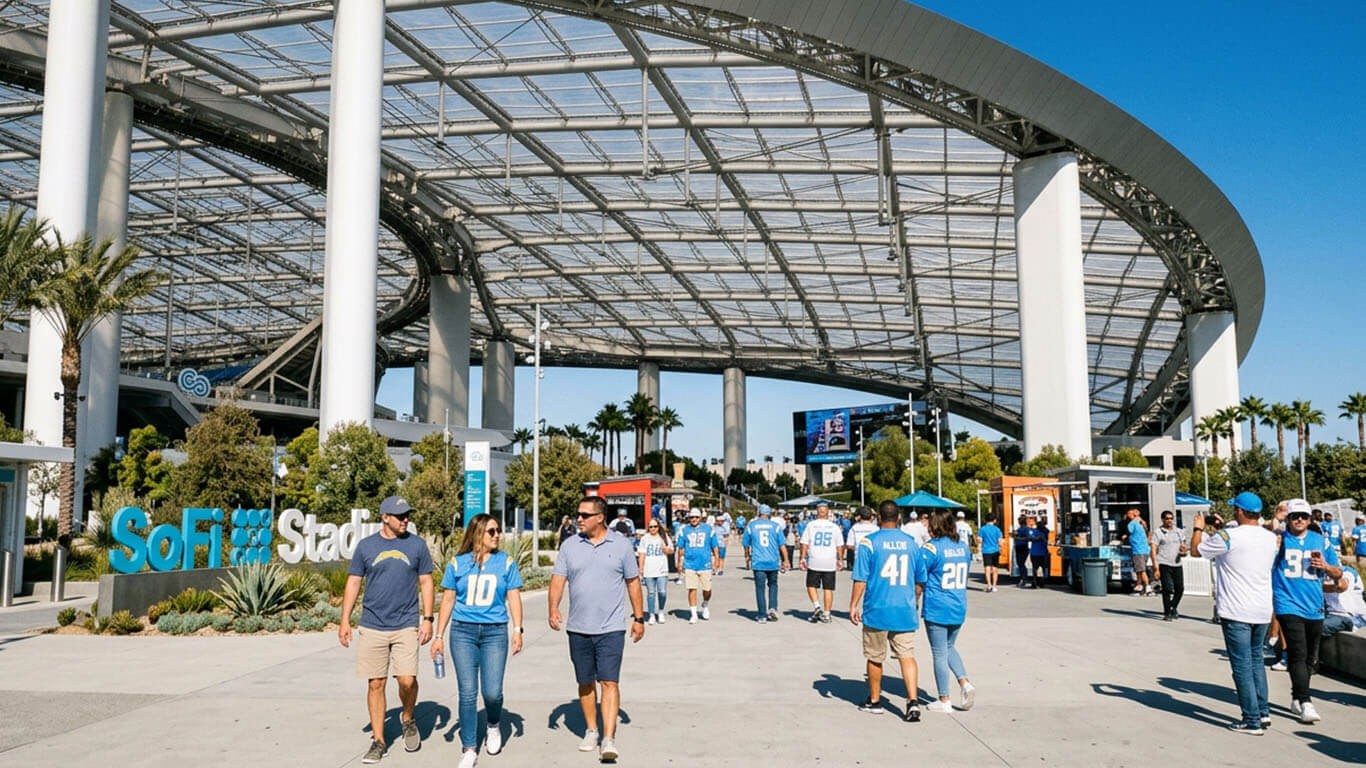
SoFi Stadium is located at 1001 Stadium Drive in Inglewood, California, the centerpiece of the larger Hollywood Park development that also includes the Kia Forum and the Intuit Dome. Unlike NFL venues tucked deep into city cores or pushed far out from major hotel districts, this Los Angeles venue sits just east of LAX with direct freeway access from I-405, I-105, and La Cienega Boulevard, plus a Metro K Line connection at the new LAX/Metro Transit Center that opened in June 2025. Routes from across the Los Angeles basin all funnel into the Inglewood area, so Los Angeles travel from the South Bay, Westside, downtown, the San Fernando Valley, and Orange County tends to converge on the same handful of streets in the hour before kickoff.
Los Angeles travel choices for travel to a Chargers weekend also depends heavily on where fans choose to stay. A hotel near LAX, in El Segundo, or in Manhattan Beach puts you within a 10 to 15 minute drive of SoFi and connects naturally with the Metro shuttle on Los Angeles Chargers game day. A hotel in downtown Los Angeles, Hollywood, or Santa Monica means you are leaning on the K Line, the SoFi shuttle, rideshare, or driving to get into the building, which changes how early you need to leave and how flexible you can be after the game. Picking the right combination of hotel and travel transportation is often what makes the difference between a relaxed Chargers game day and a frustrating one. For Chargers fans who would rather skip the travel planning entirely, Los Angeles Chargers travel packages bundle hotel, tickets, and SoFi Stadium logistics into one organized Los Angeles Chargers travel itinerary.
The goal here is not just getting to SoFi, but doing it in a way that protects the rest of the Los Angeles Chargers travel weekend. A Los Angeles Chargers weekend usually involves Los Angeles food stops, beach time, Hollywood, and a few late nights, and how you handle the Los Angeles travel during the game day portion of the broader travel weekend directly affects everything else. The available options are all reasonable, but each has tradeoffs, and the right choice depends on hotel location, kickoff time, and how much flexibility you want before and after the Chargers game.
Flying In for a Chargers Game: Airport Information
Los Angeles International Airport (LAX) is the primary point of entry for Los Angeles travel and sits about three miles west of SoFi Stadium and roughly 18 miles southwest of downtown Los Angeles. The drive between LAX and the building takes 10 to 20 minutes outside of game day rush hour, which makes Los Angeles Chargers travel one of the most convenient airport-to-stadium runs in the league. LAX is the busiest airport in the western United States, handled around 76 million passengers in 2024, and offers nonstop service to over 200 destinations across North America, Asia, Europe, Latin America, and Oceania.
Every major domestic and international carrier operates at LAX, including American, Delta, United, Southwest, JetBlue, Alaska, Spirit, Frontier, Hawaiian, Air Canada, WestJet, British Airways, Air France, Lufthansa, Emirates, Qantas, ANA, Korean Air, and many more. That depth of service makes Los Angeles one of the easiest NFL travel destinations to fly into, with direct flights from Toronto, New York, Chicago, Dallas, Atlanta, Miami, Boston, Denver, Vancouver, Mexico City, London, Tokyo, and Sydney giving Chargers travelers strong same-day arrival options.
For Los Angeles Chargers travel plans where LAX schedules or fares do not work, several secondary airports cover the broader region. Hollywood Burbank (BUR) sits about 25 miles north and works well for travelers staying in the San Fernando Valley or Hollywood, Long Beach (LGB) sits about 20 miles southeast and is convenient for South Bay or Orange County hotels, and Ontario International (ONT) sits about 50 miles east and is sometimes worth the longer drive when fares are significantly cheaper. John Wayne Airport (SNA) in Orange County is also viable for fans staying in the Anaheim or Newport Beach area, though it is roughly 40 miles from SoFi Stadium and adds significant freeway exposure on Los Angeles game day traffic.
For most Los Angeles Chargers travel itineraries, LAX is the right starting point. The three-mile gap between the airport and SoFi Stadium gives Los Angeles Chargers fans flexibility to land in the morning, drop bags at a Los Angeles hotel, and still have several hours before kickoff. Rental cars are the dominant choice from LAX for Chargers travel because Los Angeles geography rewards having a vehicle for hotel-to-stadium runs and for everything else the city offers. The same proximity makes it easy to fly out of Los Angeles the morning after a Sunday Chargers game without rushing through traffic, which matters for fans tying the trip to a longer Los Angeles Chargers travel itinerary.
Driving and Parking at SoFi Stadium for Chargers Games
Driving is one of the most common ways many fans get to SoFi, but Los Angeles traffic and limited on-site parking make the math more complicated than at most NFL venues. The Hollywood Park parking ring around the building is divided into Hyundai-branded color zones (Pink, Blue, Brown, Green, Orange, Purple) plus Stadium VIP and East VIP, with all on-site passes managed mobile-only through the team Account Manager. Lot capacity for general public is limited and routinely sells out for divisional and primetime Chargers games, so advance purchase is the norm rather than the exception.
SoFi Stadium parking runs $50 to $130-plus per Chargers game depending on zone proximity, with Stadium VIP and East VIP pricing higher and tied to specific season ticket holder benefits. Hyundai Pink Zone is the only on-site lot that allows tailgating, and it is also where oversized vehicles like RVs and buses must purchase a separate Lot P (POVR) pass that sells out on a season-long basis. Hyundai Blue, Brown, Green, Orange, and Purple are no-tailgating zones with strict no-circulation rules, meaning you cannot move between zones once parked. Parking lots open four hours before kickoff for most Chargers games, with Hyundai Pink Zone opening five hours before to accommodate tailgating setup.
Off-site parking through the Inglewood Park & Go program is the strongest backdoor option for Los Angeles travel plans where on-site sells out. The City of Inglewood operates 4,000-plus remote parking spaces at multiple lots in and around the area, with free 15-minute shuttle service to the Intermodal Transit Facility next door to SoFi Stadium. Shuttles begin three hours before kickoff and continue 90 minutes after the game ends, return shuttles start at the end of the third quarter, and pre-booking through the Inglewood Park & Go portal saves significant money over drive-up rates. ParkWhiz and SpotHero also offer reservable off-site spots in nearby commercial lots and parking structures, typically running $30 to $60 per Chargers game.
Street parking is not an option in Inglewood. The City of Inglewood enforces a residential parking permit program on every street within the area, and game day enforcement through ticketing, citations, and towing is aggressive. There is no event street parking permitted in any Inglewood residential neighborhood, so any travel plan that assumes "park on the street and walk" will fail and likely result in a tow. The Market Place commercial area adjacent to the building also strictly prohibits non-customer parking and tows aggressively for Chargers games.
Exit strategy matters more at SoFi Stadium than at most NFL venues because Inglewood streets are narrow, the on-site lots close one hour after the final whistle, and Los Angeles traffic on I-405 and I-105 stacks up quickly. Fans who want a faster departure either stay in the lot for an extra 30 to 45 minutes after the final whistle or skip driving entirely and use the Metro K Line through the LAX/Metro Transit Center. Both strategies cut significant time off the post-game drive and avoid the slowest Los Angeles travel windows.
Public Transit to SoFi Stadium for Chargers Games
Public transit is one of the strongest reasons Chargers fans skip parking entirely for a home game, in part because LA Metro operates a free SoFi Stadium Shuttle from the new LAX/Metro Transit Center that opened on June 6, 2025. That single facility changes the math for a lot of visiting fans, since it eliminates the cost of parking and connects the C Line, K Line, and 11-plus Metro bus routes into one efficient game day travel hub.
The LAX/Metro Transit Center sits at 9225 Aviation Boulevard at 96th Street, just east of LAX, and is served by both the C Line (running east-west between Norwalk and Redondo Beach) and the K Line (running north-south between Expo/Crenshaw and Redondo Beach via Inglewood). C Line trains run every 10 minutes most of the day, K Line trains every 10 minutes most of the day and every 20 minutes after 8 p.m. The free SoFi Stadium Shuttle runs from Bus Bay 8 every three to five minutes beginning three hours before kickoff, return service starts at the beginning of the fourth quarter and continues for 90 minutes after the Chargers game ends. The previous Hawthorne/Lennox shuttle route is no longer in service.
For Chargers travel plans coming from elsewhere in the Los Angeles area, the K Line connects to most of the city through transfers. From downtown Los Angeles, ride the E Line west toward Santa Monica and transfer at Expo/Crenshaw to the K Line southbound. From Long Beach, ride the A Line north to Willowbrook/Rosa Parks and transfer to the C Line. From Hollywood or the San Fernando Valley, ride the B Line south to 7th/Metro and transfer to the E Line, then transfer to the K Line. Standard Metro adult fare is $1.75 one-way or $3.50 round-trip, with the SoFi shuttle itself free.
Public transit works best for Los Angeles travel plans where the hotel location aligns with a Metro rail station. A room at an LAX-area hotel, in El Segundo, in downtown Los Angeles near 7th/Metro, in Long Beach, or near Expo/Crenshaw puts you within easy reach of the K Line or C Line. A hotel in Santa Monica, Beverly Hills, or out in the Valley does not connect cleanly to the Chargers game day rail network, so fans in those areas almost always rely on rideshare, driving, or a combined Metro-and-Uber strategy instead.
Rideshare to SoFi Stadium for Chargers Games
Uber and Lyft operate throughout Los Angeles and are one of the most popular ways for Chargers fans to reach SoFi Stadium, especially for fans staying in Santa Monica, Hollywood, downtown, or anywhere outside the Inglewood and South Bay area where driving and parking are most efficient. The dedicated rideshare zone is on Kareem Court accessed via westbound Pincay Drive, with the official drop-off and pickup address listed as 3178 Pincay Drive, Inglewood, CA 90305. Drivers are routed onto the northbound curb lane on Kareem Court for drop-off and pickup, which keeps them out of the heaviest pedestrian traffic.
Arrival by rideshare is straightforward in most cases. Entering the official SoFi Stadium address in the Uber or Lyft app routes drivers to the Kareem Court zone automatically, and most local Los Angeles drivers know the Chargers game day routing well after years of Rams games, Chargers games, concerts, the Super Bowl LVI, and the College Football Playoff National Championship. Pickup times before kickoff are typically reliable as long as fans request a ride at least 45 minutes to an hour before they want to be inside the building.
Post-game rideshare demand changes the picture quickly. Surge pricing on Uber and Lyft routinely doubles or triples within the first 20 minutes after a Chargers game ends, and surge pricing is some of the most aggressive in the NFL because of the surrounding entertainment and event volume. The most effective workaround is to walk 15 to 20 minutes east toward the Inglewood Park & Go shuttle pickups or the Metro Intermodal Transit Facility and request a ride from those areas, which avoids the demand spike near SoFi and routes drivers from a much wider Los Angeles pool of vehicles. This single move often saves $30 to $60 per ride.
Rideshare works best for Los Angeles travel plans that prioritize simplicity over flexibility. A fan staying at a Santa Monica or Hollywood hotel who only plans to attend the game and then return to the room is well served by Uber or Lyft, especially with the small post-game walk to a calmer pickup zone. A fan who wants to bounce from the building straight to dinner in Manhattan Beach or up to West Hollywood will get more value out of having a car or a planned hotel-to-restaurant travel route through the Metro K Line.
Did You Know: SoFi Stadium
SoFi Stadium opened on September 8, 2020 as the new home of both the Los Angeles Rams and the Los Angeles Chargers, who had relocated from San Diego in 2017. Construction cost roughly $5.5 billion total, making SoFi the most expensive sports venue ever built at the time of its opening. The first NFL game played there featured the Rams hosting the Dallas Cowboys on a Sunday Night Football opener, played without fans because of the COVID-19 pandemic, and it took until the 2021 season for the building to host its first event with full capacity.
The naming history of the venue is brief by NFL standards. SoFi Technologies, the San Francisco-based personal finance company, signed a 20-year naming rights deal in 2019 before the building opened, and the name has not changed since. Beyond Chargers and Rams games, SoFi Stadium hosts the annual LA Bowl, major concerts from artists like Taylor Swift, Beyoncé, Kendrick Lamar, and the Eagles, the Super Bowl LVI in February 2022, the College Football Playoff National Championship in January 2023, and a major slate of FIFA World Cup 2026 matches. The venue will also host the opening and closing ceremonies of the 2028 Summer Olympics in Los Angeles.
The geography and design of the venue are central to the Los Angeles fan experience. SoFi Stadium sits on 298 acres at the heart of Hollywood Park, just west of The Kia Forum and adjacent to the new Intuit Dome that opened in 2024 as the home of the Los Angeles Clippers. The building is a sunken open-air bowl with a translucent ETFE roof that protects fans from sun and rain without enclosing the space, capacity sits at 70,000 with expansion to 100,000-plus for major events like the Super Bowl and World Cup, and the open-air design uses Pacific Ocean breezes for natural climate control without traditional air conditioning.
Plan Your Los Angeles Chargers Trip With Elite Sports Tours
At Elite Sports Tours, planning how to get to SoFi Stadium is built into the structure of every Chargers travel itinerary from the beginning. Hotel location, arrival timing, walkability, transit access, and parking strategy all affect how smooth a Los Angeles Chargers weekend feels once you land in Los Angeles. Instead of leaving those decisions to the last minute, our travel team helps line up the pieces in a way that reduces friction and protects the quality of the overall Los Angeles travel experience.
This matters most for out-of-town visitors who are flying into LAX, checking into a Los Angeles hotel, and trying to judge whether driving, the Metro K Line, the SoFi shuttle, rideshare, or off-site Inglewood Park & Go is the better fit for their schedule. The right choice depends on where you stay in Los Angeles, when you arrive, and how much flexibility you want before and after kickoff. When those travel details are planned properly, the entire Chargers experience feels easier and more controlled, and the SoFi portion of the weekend stops competing for attention with everything else the city offers.
For Chargers fans looking to simplify the entire travel process, Los Angeles Chargers travel packages combine game tickets, hotel accommodations in optimal Los Angeles locations, and a structured approach to getting to SoFi Stadium. This removes uncertainty and allows you to focus on the experience rather than the logistics.
Los Angeles Chargers Transportation FAQ
What is the best way to get to SoFi Stadium for Chargers games?
For Los Angeles travel plans that include a hotel near LAX, in El Segundo, or in Manhattan Beach, driving with a pre-purchased Hyundai zone parking pass is the most reliable option for most kickoff times. For Los Angeles travel plans based in downtown Los Angeles, Long Beach, or anywhere along the K Line or C Line, the Metro rail with the free SoFi Stadium Shuttle from the LAX/Metro Transit Center tends to be the cleanest fit.
How much is parking at SoFi Stadium?
On-site Hyundai zone parking runs $50 to $130-plus per Chargers game depending on zone proximity, with Stadium VIP and East VIP pricing higher. All passes are mobile-only through the Chargers Account Manager. Inglewood Park & Go offers off-site parking with shuttle service starting at lower price points, and ParkWhiz or SpotHero spots typically run $30 to $60 per Chargers game.
Is there public transit to SoFi Stadium?
Yes. LA Metro operates a free SoFi Stadium Shuttle from the LAX/Metro Transit Center, which is served by both the C Line and K Line. Buses run every three to five minutes from Bus Bay 8 starting three hours before kickoff, with return service starting at the beginning of the fourth quarter and running 90 minutes after the Chargers game.
Can you take Uber or Lyft to SoFi Stadium?
Yes. Both Uber and Lyft operate throughout Los Angeles, and the dedicated rideshare zone is on Kareem Court via westbound Pincay Drive, with the official pickup address listed as 3178 Pincay Drive, Inglewood, CA 90305. Post-game surge pricing is significant, so walking 15 to 20 minutes east toward the Intermodal Transit Facility before requesting a ride is the standard way fans avoid inflated fares.
How early should you arrive at SoFi Stadium?
Most Chargers fans arrive 90 minutes to two hours before kickoff to clear the security gates without stress and to spend time in the parking lots, where Hyundai Pink Zone tailgating opens five hours before the Chargers game and the other Hyundai zones open four hours before. Driving fans should add 30 to 45 minutes during divisional and primetime games when traffic on I-405 and I-105 runs heaviest in Los Angeles.
Explore More Los Angeles Chargers Travel Guides
Want to get the most out of your Los Angeles Chargers trip? Check out these related guides to ensure the journey is seamless and enjoyable:
- Los Angeles Chargers Travel Guide for Fans: Build a complete Los Angeles Chargers travel plan with insights on how to structure your trip around a game.
- Best Hotels Near SoFi Stadium for Los Angeles Chargers Games: Find the best hotel options for Los Angeles Chargers matchups when planning the trip.
- How to Get to SoFi Stadium for Los Angeles Chargers Games: Plan the perfect Los Angeles trip to catch a Chargers home matchup live at SoFi Stadium.
- Best Seats and Ticket Options at Los Angeles Chargers Games: Section-by-section seat analysis and tickets guide at SoFi Stadium.
- Where the Los Angeles Chargers Stay on the Road: Curious where the pros stay? Learn about the hotel options NFL teams use when traveling on the road.
- Los Angeles Chargers Stadium Tours at SoFi Stadium: Take a behind-the-scenes look at the venue with exclusive tours and insider access.
- Los Angeles Chargers Travel Packages: Browse all current Los Angeles Chargers Travel Packages that include tickets, hotels and optional flights for your next game.
Editorial Note & Travel Expertise
This guide is based on real-world experience planning Los Angeles travel and helping fans navigate SoFi Stadium across different types of trips. Every recommendation reflects how transportation, parking, and arrival timing actually work when attending Chargers games, not just general directions or surface-level advice. SoFi Stadium is one of the more transit-accessible NFL venues now that the LAX/Metro Transit Center is open and the K Line and C Line both run game day shuttle service, but the way you organize your arrival still has a direct impact on how smooth the Chargers travel day feels.
Los Angeles Chargers travel often involves more than just getting to SoFi Stadium. Hotel location, flight timing into LAX, and Chargers travel transportation choices all connect, and small decisions can change how efficiently you move throughout the trip. The goal of this guide is to provide practical, accurate information so you can build a travel plan that fits your schedule, avoids unnecessary delays, and allows you to focus on the Chargers travel experience once you arrive.
Travel Information Disclaimer
Transportation routes, parking availability, and transit schedules for SoFi Stadium can change based on game-day operations, city planning, and Chargers demand. Parking prices, lot access, and shuttle availability may vary depending on the schedule and attendance levels.
Public transit services, including Metro rail and the SoFi Stadium Shuttle, may adjust frequency or timing based on Chargers game schedules. Rideshare availability and wait times can fluctuate significantly before and after games depending on demand. Travelers should confirm current transportation details, parking options, and timing closer to their travel date to ensure the most accurate Los Angeles Chargers travel planning around SoFi Stadium.
Updated April 2026