Chicago Bears Stadium Tours – Soldier Field
Chicago Bears Stadium Tours – Soldier Field explains what visitors can expect during guided tours of one of the NFL’s most historic venues, including access to seating areas, premium spaces, and behind-the-scenes sections depending on stadium operations and event scheduling. Tour routes and availability can change throughout the year based on the Chicago Bears schedule and other events at Soldier Field. This guide also helps fans coordinate tours with tickets, nearby hotels, and Chicago Bears travel packages.
Chicago Bears Stadium Tours at Soldier Field
Soldier Field tours are the part of a Chicago Bears trip most travelers skip on a first visit. Tickets and seating get most of the attention, but the building shapes the entire Chicago weekend in ways a seating map cannot communicate. Walking it before kickoff is what changes how the weekend actually unfolds. No other NFL building carries the layered history of Soldier Field, the league's oldest active stadium and where the Bears have played since 1971.
Chicago is one of the most-visited destinations on the NFL travel circuit, and Soldier Field is the centerpiece of that draw. The Bears organization is in the middle of a long stadium decision involving Arlington Heights and a Hammond proposal still under league review through 2026, but kickoff for the immediate future still happens on the Near South Side lakefront. Bears tours give visitors context that a ticket purchase alone does not. Without seeing the venue in advance, fans tend to make seating decisions based on a chart that cannot capture how the modern bowl sits inside the 1924 colonnades.
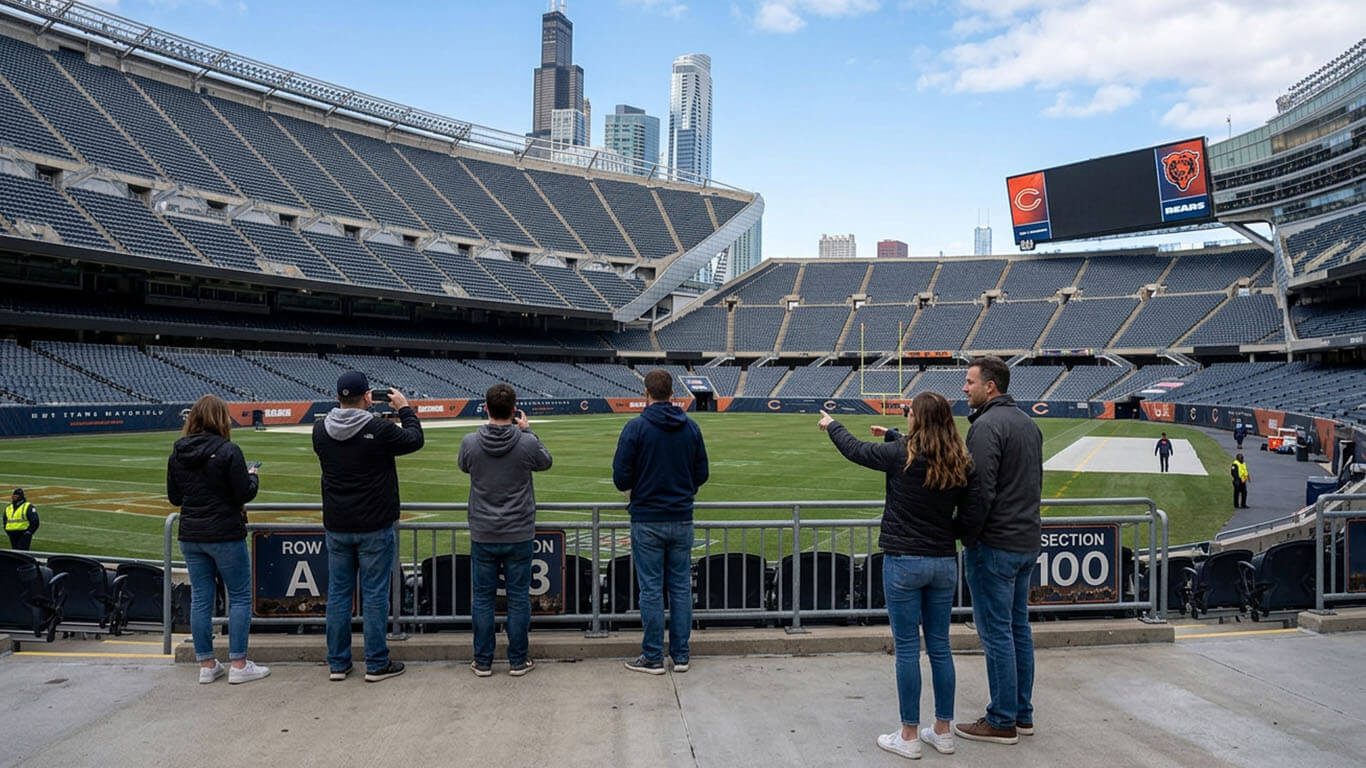
Tours give travelers structured access to the spaces that explain how the building functions on game day. The visitor locker room, the playing surface, the south colonnades, the Skyline Suite, and the video control room sit on different tiers depending on which route is booked. Seeing these areas in advance reshapes how Chicago fans approach parking, gate selection, and arrival timing around the Museum Campus.
Chicago is a destination city for football travelers from across the Midwest, and arriving without a sense of how the venue feels in person usually leads to a rushed weekend. Tours at the venue are the most direct fix. For first-time visitors, the routes set the foundation for everything that follows around the Chicago lakefront and the downtown core.
What You Experience on Chicago Bears Stadium Tours
Tours at Soldier Field are built around access and the contrast between the historic exterior and the modern interior bowl. The Chicago Park District offers two public routes. The Classic Stadium Tour runs roughly 60 minutes through the south courtyard, the visitor locker room, interview spaces, the Skyline Suite, the colonnades, and the playing-surface perimeter. The VIP Stadium Tour layers everything in the Classic route with a 15-minute on-surface experience and a stop inside the video control room. Private group routes are available for school groups, corporate visits, and parties of ten or more guests, scheduled directly through the venue.
Every public route begins at Gate 1 on the south side of Soldier Field, at 1410 Special Olympics Drive. Tour pricing as of early 2026 sits at twenty dollars for adults on the Classic route and twenty-seven dollars for adults on the VIP route, with discounts for kids, military, and seniors. Tickets are reserved online in advance through the venue, and travelers check in fifteen minutes before the scheduled start. The standard NFL clear bag policy applies during major event windows.
Walking onto the playing surface is the centerpiece of the VIP route. Visitors stand at ground level on the same surface where the 1985 Bears defense set the franchise high-water mark. Distances that look similar on a chart turn out meaningfully different in person. The lakefront wind that defines so many Bears home games registers differently once you can see how the open north end frames the bowl.
The visitor locker room is the operational space the routes actually access. The Bears locker room is held back for team-only use, so tours walk visitors through the opposing-team space and the adjacent interview rooms where post-game press conferences are conducted. Most NFL routes follow the same standard.
The Skyline Suite is the premium area the routes tour next, and it gives visitors a clear sightline across the bowl from the south end. From there, tours move through the south colonnades, the original 1924 elements that survived the controversial 2002-2003 renovation. Walking the colonnades from inside the building is the architectural moment most casual ticket holders never reach. The Doric columns rise above the bowl on the east and west sides at the height the Holabird and Roche design specified more than a century ago.
The VIP route adds the video control room, where every replay, scoreboard cut, and broadcast feed runs during a Chicago Bears home game. For visitors who have only seen the bowl from the seats, that operational layer reframes how a Bears game gets produced.
Beyond the operational spaces, the route weaves through identity markers. The Doughboy statue at the north end honors the World War I U.S. soldiers Soldier Field was rededicated to in 1925. The Gold Star Families Memorial Monument marks the broader memorial purpose that distinguishes the venue from every other NFL stadium. The exterior memorials are part of why the building was designated a National Historic Landmark in 1987.
Unique Features of Soldier Field
Soldier Field is one of the most architecturally polarizing buildings in American sports, and that becomes obvious once visitors walk the bowl during tours. The original 1924 design by the Chicago firm Holabird and Roche placed a U-shaped seating bowl inside a neoclassical exterior with Doric colonnades rising roughly 110 feet on the east and west sides. The Wood and Zapata renovation completed in 2003 demolished the original interior and inserted a modern steel-and-glass seating bowl inside the surviving 1924 shell. The result is divisive. The New York Times named the renovated Soldier Field one of the five best new buildings of 2003, while Chicago Tribune critic Blair Kamin called it an "Eyesore on the Lake Shore."
The naming history is one of the few things every Chicago resident agrees on. Soldier Field opened on October 9, 1924, as Grant Park Stadium, the 53rd anniversary of the Great Chicago Fire. On November 11, 1925, on Armistice Day, the building was renamed Soldier Field to honor U.S. soldiers who died in World War I. The formal dedication ceremony ran on November 27, 1926, during the Army-Navy game that drew over 100,000 spectators. The Soldier name has stuck for a century, and no corporate naming rights have ever been sold here.
The building sits on Chicago's Museum Campus along Lake Michigan, at 1410 Special Olympics Drive. The address changed from McFetridge Drive in 2018 to mark the 55th anniversary of the first Special Olympics, hosted here in 1968. Football capacity is 61,500, the smallest in the NFL by a meaningful margin, which has been one of the central drivers behind the Bears organization exploring Arlington Heights and Hammond as new-stadium sites. The bowl carries four primary tiers around the U-shape: lower bowl, club level, suite level, and upper bowl, with the open north end framing the lakefront and the downtown Chicago skyline.
The Doric colonnades are the surviving element that justifies the historic-landmark conversation. The 2003 renovation preserved them on the east and west exteriors while replacing everything inside. Tours walk visitors through the inside of the colonnades, which is the architectural moment that anchors the building's identity. The 2003 renovation cost roughly $660 million and led to Soldier Field losing its National Historic Landmark designation in 2006, which most tour guides reference when walking the east-side route.
Tradition at Soldier Field is built around the Bears franchise and the broader civic role the building plays in Chicago. The Bears moved into Soldier Field full-time in 1971 after previously playing at Wrigley. The 1985 NFC Championship win over the Los Angeles Rams remains the franchise's defining home moment. Walter Payton, Mike Singletary, Dick Butkus, Brian Urlacher, and Devin Hester are the names guides reference most when walking the route.
Soldier Field hosts well beyond Bears games. Chicago Fire FC of Major League Soccer has played here since 2020, and Soldier Field is one of the U.S. host venues for the 2026 FIFA World Cup, which brings global attention back to the Chicago lakefront. The 2026 concert calendar carries Bruno Mars, Ed Sheeran, Karol G, Foo Fighters, and BTS. The 1968 Special Olympics, the 1994 FIFA World Cup matches, and the 2016 Copa América Centenario final between Chile and Argentina have all run through the venue.
Why Chicago Bears Stadium Tours Are Worth It
Tours at Soldier Field are worth doing because they change how visitors approach the entire Chicago trip. Travelers tend to arrive with limited understanding of the building, which leads to poor seating choices and missed parts of the venue casual visitors never reach. The smallest stadium in the NFL behaves differently from a 70,000-plus venue, and walking it in advance is the only way to internalize that scale.
The access tours provide is not available on a standard visit. The visitor locker room, the playing surface, the Skyline Suite, the colonnades, and the video control room each carry context that reshapes how the building feels during a Bears game. Chicago fans understand the layout before they need it, instead of figuring it out while moving through narrow concourses with 61,000 other people.
Ticket decisions are where these tours pay off most. The lower bowl wraps the playing surface tightly along the sidelines and end zones. The club level adds amenities and indoor space, which matters more here than at warm-weather stadiums given the late-season Chicago weather. The suite level carries premium options, and the upper bowl trades proximity for sweeping views of Lake Michigan and the downtown Chicago skyline through the open north end. Standing inside each tier during tours is the honest way to compare them.
Time efficiency matters at the venue because of how parking works around the Museum Campus. The Bears do not control most of the surrounding lots, which are pre-sold to season-ticket holders. Visitors typically rely on the 31st Street McCormick Place Lot, the Millennium Park garages, or the CTA Red, Green, and Orange lines into Roosevelt Road. Walking the building during tours makes gate decisions easier on game day.
The emotional layer is the other reason these tours hold up for repeat Bears fans. Standing on the playing surface, walking inside the colonnades, and seeing where the 1985 Bears defense operated changes how a visitor watches the team. Long-time Chicago fans come away understanding what gets preserved across the building's eras, including the looming Arlington Heights transition.
The only real tradeoff is timing. Tours do not run on Bears home gamedays, and the schedule pauses around major Chicago Fire matches, the bigger concerts, and the 2026 World Cup matches. For a tight weekend, Chicago travelers decide whether two hours is better spent at the Shedd Aquarium across the Museum Campus or inside the building itself. For a Bears-focused trip the answer is the building.
Planning Chicago Bears Tours with Flights, Hotel and Tickets in One Package
Tours at the venue are one piece of a Chicago Bears trip. The harder piece is coordinating Bears tickets, hotels in downtown Chicago or the South Loop, and travel timing so the rest of the weekend works around the Museum Campus and the lakefront. Travelers tend to book those pieces separately, which leaves gaps between where they stay, when they arrive, and how easily they reach the building on game day.
Elite Sports Tours packages Bears tickets, hotel accommodations, and optional flights into one structured booking. Hotels are positioned for access to the venue through the South Loop and the downtown Chicago core, and Bears tickets come from real availability rather than the secondary-market inventory that vanishes hours before kickoff.
Bundling Chicago travel into one package usually produces better overall pricing than booking each component separately. Hotels in downtown Chicago and the South Loop swing sharply with demand, especially around primetime Bears games against NFC North rivals like the Packers, Lions, and Vikings. Bears ticket prices shift based on opponent, day of week, and weather forecast. Check out Chicago Bears Travel Packages.
Chicago Bears Stadium Tours FAQ
How do you book Chicago Bears tours at Soldier Field?
Tours are booked through the official venue website, with both Classic and VIP routes available on the public schedule. Tickets are reserved online in advance, and travelers check in fifteen minutes before the scheduled start at Gate 1. Private group routes for ten or more guests are arranged directly through the venue.
What do Chicago Bears tours include at Soldier Field?
The Classic route walks visitors through the south courtyard, the visitor locker room, interview spaces, the Skyline Suite, the colonnades, and the playing-surface perimeter. The VIP route adds a fifteen-minute on-surface experience and a stop inside the video control room. Both routes start and end at Gate 1.
Can you go on the playing surface during a Soldier Field tour?
The VIP route includes on-surface access for roughly fifteen minutes. The Classic route reaches the perimeter but does not include the on-surface component. Access can shift based on conditions, weather, and any event scheduled at the venue.
How long are Chicago Bears tours?
The Classic route runs roughly 60 minutes. The VIP route runs closer to 75 to 90 minutes with the added on-surface time and the video control room stop.
Are Chicago Bears tours available on game days?
Standard public tours do not run on Bears home gamedays at the venue. The schedule also pauses around the largest Chicago Fire matches and major concerts. Fans planning a Bears trip should book a Classic or VIP route for a non-game day during the same weekend.
Are Soldier Field tours worth it?
Tours are most valuable for first-time visitors and for Bears fans who want to evaluate seating tiers in person before committing to a tour ticket or a game ticket. The on-surface VIP component, the Skyline Suite sightlines, and the walk inside the historic colonnades carry the most weight.
When is the best time to take a Chicago Bears tour?
The Classic and VIP routes run on most non-event weekdays and select weekend dates. The strongest windows are mid-March through mid-May and early September.
Where do Chicago Bears tours start at Soldier Field?
All public routes begin at Gate 1 on the south side of the building at 1410 Special Olympics Drive on the Museum Campus. Travelers arrive fifteen minutes before the scheduled start. The standard NFL clear bag policy applies during event-week windows.
Can you plan Chicago Bears tours as part of a travel package?
Tours are booked separately through the venue rather than bundled into standard travel packages. They can still be scheduled alongside a Chicago trip with Bears tickets and hotel accommodations through Elite Sports Tours.
Explore More Chicago Bears Travel Guides
Planning a trip to see the Chicago Bears involves more than just buying tickets. Hotel location, access, seating strategy, and transportation timing can all impact your overall game-day. These guides help break down each part of the planning process so you can compare tickets, hotels, and travel options more efficiently.
- Chicago Bears Travel Guide for Fans: Build a complete Chicago Bears travel plan with insights on how to structure your trip around a game.
- Best Hotels Near Soldier Field for Chicago Bears Games: Compare the top hotel areas near Soldier Field, including Downtown Chicago, the Loop, and South Loop options commonly used in Chicago Bears Travel Packages.
- How to Get to Soldier Field for Chicago Bears Games: Learn the best driving routes, parking options, CTA access points, rideshare zones, and game-day transportation strategies around Soldier Field.
- Best Seats and Ticket Options at Chicago Bears Games: Section-by-section breakdown of seating views, premium areas, lower bowl options, club seats, and ticket strategies for Bears games.
- Where the Chicago Bears Stay on the Road: Explore known team hotel patterns and travel insights for fans planning Chicago Bears away-game trips.
- Chicago Bears Stadium Tours at Soldier Field: Learn what is included on Soldier Field tours, including locker room areas, and behind-the-scenes experiences.
- Chicago Bears Travel Packages: Explore complete Chicago Bears Travel Packages that include tickets, hotels and optional flights for your next game.
Editorial Note & Travel Expertise
This page is written from the perspective of planning real Chicago Bears trips. Soldier Field is the oldest active stadium in the NFL, the smallest by capacity, and the only venue with a 1924 neoclassical exterior wrapped around a 2003 modern seating bowl. How fans experience the building depends on where they sit and which tour route matches the structure of the trip.
Tours are included here because they directly shape those decisions. Walking the playing surface, standing inside the Skyline Suite, and moving through the south colonnades changes how Chicago visitors plan game-day timing on a tour. The Doughboy statue, the Gold Star Families Memorial, and the Special Olympics legacy become visible only during a guided tour. The Arlington Heights stadium decision still in motion through 2026 adds another layer for Bears fans planning current-season visits.
Elite Sports Tours has built its platform around the broader trip-coordination problem. Bears fans are not just buying tickets. They are planning a Chicago trip around a live game in a city where Museum Campus parking, downtown hotels, and stadium access all move independently unless coordinated.
Travel Information Disclaimer
Tours at the venue are subject to availability, scheduling changes, and operational restrictions set by the Chicago Bears organization, Chicago Fire FC, and venue operations. Access to the visitor locker room, the playing surface, the Skyline Suite, the colonnades, and the video control room may vary based on tour tier, weather, and game-day operations.
Hotel availability near the venue and Bears ticket pricing change with demand, opponent, and booking timing. Travel times and routes around the Museum Campus vary with traffic patterns, Bears game schedules, Chicago Fire matches, and concert dates.
Always confirm current Chicago Bears tour availability, Soldier Field policies, and tour route details before finalizing your plans.
Updated May 2026