Best Seats and Ticket Options at Washington Capitals Games
Best Seats and Ticket Options at Washington Capitals Games explains the best places to sit at Capital One Arena based on sightlines, atmosphere, amenities, and budget. Centre-ice lower bowl seats offer the best overall views, while upper-level sections provide excellent value for fans looking to experience Capitals hockey at a lower price. This guide compares Washington Capitals tickets, premium seating, club options, and complete travel packages with hotels for fans planning a game in Washington, D.C.
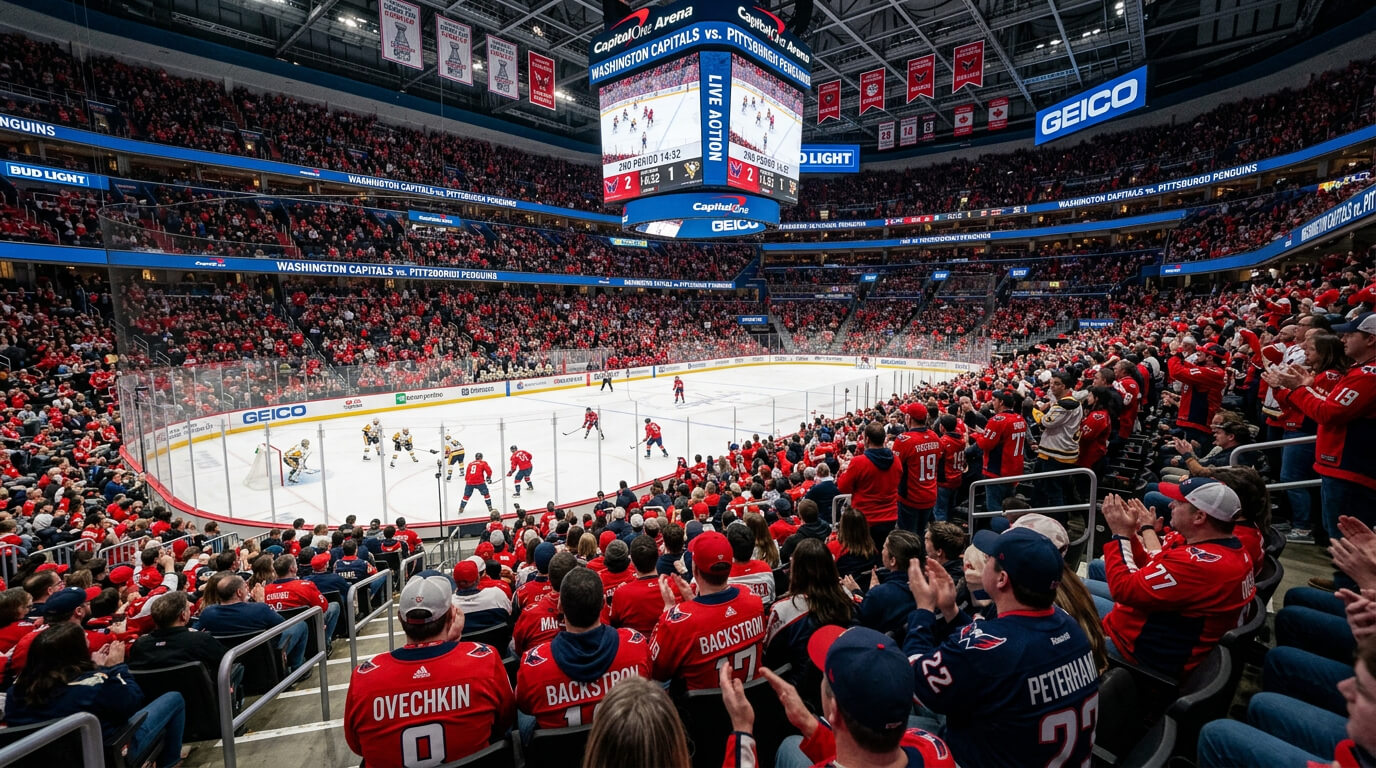
Best Seats and Ticket Options at Washington Capitals Games
Capital One Arena runs an 18,506-hockey bowl with the Washington Capitals bench between sections 100 and 121, the visiting bench between sections 100 and 101 on the same sideline, and the penalty boxes at section 111 on the opposite sideline. The Washington Capitals shoot twice toward the goal in front of 105 and 106 in the first and third periods, and the visiting team shoots twice toward the goal in front of the 116/117 pair for those two periods - direction of play determines which end tickets deliver the offensive-zone action for each team. Peak atmosphere hits on a home goal, a snipe from the dot, or a stretch pass through the neutral zone against Pittsburgh, Philadelphia, or Carolina. An extra thirty dollars can push you two rows closer to the ice in the lower bowl or into Ultra Club tickets with the private-lounge amenity umbrella and premium concessions. Bundling Washington Capitals tickets with a downtown DC hotel steps from Metro Gallery Place-Chinatown station through Washington Capitals Travel Packages keeps the budget honest, and you're not overspending on a premium ticket because the rest of the trip got underbooked.
The venue opened in December 1997 as MCI Center, ran as Verizon Center from 2006 through 2017, and took the Capital One Arena name in 2017 when the naming rights sponsor signed the naming rights deal. The building sits at 601 F NW in the Chinatown / Gallery Place neighborhood of downtown DC, five steps from the Metro Gallery Place-Chinatown station on the Red, Green, and Yellow lines. The Washington Capitals are a franchise founded in 1974 with their only Stanley Cup in 2018, and the current era carries the weight of a captain chasing the all-time goal record while the roster runs deep playoff runs on a regular schedule. The ticket market swings hard between softer weekday visits against Western opponents and Metropolitan Division weekend games against Pittsburgh in the historic Ovechkin-Crosby rivalry, Philadelphia, the New York Rangers, the Islanders, New Jersey, Carolina, and Columbus, plus any Original Six visit from Toronto, Montreal, Boston, Chicago, Detroit, or a bucket-list Chicago visit. Row 1 puts you on the glass, but the aerial view that makes hockey readable disappears below row 6. Rows H through N in the same area give you the coach-eye view at lower prices. Repeat Washington Capitals regulars run everything through Washington Capitals Trip Packages instead of tabbing across five sites for a downtown DC weekend.
Row 1 behind the nets buys you the closest possible look at the puck, but the tall glass trims the far side of the play, and the video board becomes your primary tracking tool once the action swings to the opposite end. Mid-upper 400 sideline pairs run the opposite trade, priced below the lower bowl corners on non-marquee nights and delivering a full-ice view that the lower bowl end sections cannot match. Mid-upper 400 sideline pairs above 100-101 (bench side) and 110-112 (penalty box side) are the counterintuitive value pick at the venue, sitting directly above the coach-eye angle at a fraction of the Ultra Club spend. The 105/106 pair in the lower rows carry the loudest atmosphere in the building on a Pittsburgh Saturday when the Metropolitan Division rivalry hits peak volume, and the crowd energy at the Washington Capitals attacking end carries into every corner around it.
Direction of Play at Capital One Arena: Which End Does the Home Team Shoot Toward?
Direction of play at Capital One Arena determines which end tickets are worth the buy for any given matchup, and this is the single most-asked question about the lower bowl layout on any hockey seating forum. The Washington Capitals shoot twice toward the goal in front of 105 and 106 in the first and third periods, which puts offensive-zone action at that end for two of three periods on a home Washington Capitals matchup. The 102-109 corner wraps the Washington Capitals attacking end where the home top line drives the puck for two-thirds of the game, and 105 and 106 sit directly behind the goal camera. This is the loudest area in the building on a home goal, especially on a Pittsburgh Metropolitan night or any Original Six visit.
The visiting team shoots twice toward the goal in front of the 116/117 pair in the first and third periods, which is the exact opposite end from the Washington Capitals attacking direction. The 114-118 corner wraps the visitor attacking end and put you directly behind the visiting top line for two of three periods on marquee visits. This end matters just as much depending on what you want to see - an Original Six visit from Toronto, Montreal, or Boston frequently draws travel fans who fill the visitor attacking area with their own colors, and a Pittsburgh visit brings the black-and-gold contingent to that end via the I-70 corridor. Sitting on the wrong end for a Penguins Saturday is a real cost you can't fix once puck drops, since the marquee-night secondary market rarely opens up mid-game for a swap. Washington Capitals Trip Packages built around a specific matchup route to the correct end based on which team you actually want to watch attack.
How to Read the Capital One Arena Seat Map
The 100 area at Capital One Arena covers 100 through 121 wrapping the ice. Sections 100 and 121 sit on the bench sideline with the Washington Capitals bench between them, and sections 100 and 101 hold the visiting bench between them on the same sideline. Section 111 on the opposite sideline holds the penalty boxes directly in front, with row C at the box level and specific edge seats (last seat row 1 section 112, first seat row 1 section 110) sitting right next to the box doors. The 200 area (Mezzanine Level) covers 200 through 229 at intermediate elevation. The 400 area (upper bowl) covers 401 through 415+ at the top of the arena. Seat number 1 is always closest to the lower-numbered adjacent section (seat 1 in section 113 sits next to section 112).
Direction of play matters even more at the venue than at most NHL buildings because the Washington Capitals offensive-zone identity has run among the strongest in the Metropolitan Division across the Ovechkin era. Want a Washington Capitals power play up close for two of three periods? The 102-109 range covers the attacking end where the home team shoots twice, with 105 and 106 directly behind the goal. Want to watch a visiting top forward drive to the net for two of three periods? The 114-118 range sits near the visitor attacking end where opposing teams shoot twice.
VIP Glass Seats (Row A) and VIP Box East / West
The VIP Glass Seats at the venue occupy the front rows closest to the boards on the lower bowl with a comprehensive perks stack - complimentary parking, complimentary food, complimentary soft drinks, and complimentary beer and wine included with every ticket. This is the ultra-premium seat product at the venue and delivers on-the-glass proximity that only the first rows can match. The VIP designation comes with the full amenity umbrella wrapped in, and the closest-to-ice location trades sightline elevation for the visceral experience of players hitting the boards inches from your seat. This is the seat category for milestone weekends, anniversaries, and corporate hosting nights where the amenity umbrella and on-the-glass proximity justify the top-of-market spend.
VIP Box East and VIP Box West sit behind each basket (or behind each goal for hockey), with rows lettered AAA through MMM. VIP Box tickets includes complimentary parking, complimentary food, complimentary soft drinks, and complimentary beer and wine, plus more comfortable seating with additional legroom than standard sections. The VIP Box products deliver a premium hosting experience for a small corporate group of six to twelve who want the amenity stack without the on-the-glass proximity. Washington Capitals Trip Packages built around VIP Glass Seats or VIP Box tickets deliver the strongest possible hosting product for a first-time Washington Capitals visitor who wants the once-in-a-lifetime experience with a complete amenity umbrella wrapped in.
Ultra Club and The Vaults
The Ultra Club at the venue delivers premium seat access paired with an all-inclusive lounge that runs closer to a private members' space than a public arena concourse. Ultra Club holders access premium concessions, a full-service bar, upscale seating, and private-space amenities separated from the general concourse traffic. The Ultra Club sits between the standard lower bowl products and the VIP Glass Seats band, delivering a mid-market premium experience for a corporate group of four to eight who want the amenity stack at a mid-market price point. This is the natural upgrade path from a standard lower bowl ticket when the amenity umbrella justifies the mid-market premium.
The Vaults at the venue deliver another distinctive premium product - a themed hosting area with unique design language that pays tribute to the venue's DC banking-corridor location. The Vaults product fits a small hosting group who wants a distinctive amenity space separate from the general concourse. Washington Capitals Travel Packages built around Ultra Club or Vaults tickets deliver a comprehensive corporate hosting product with a downtown DC hotel room block and a dinner reservation into a single planning window on any night the Metro Gallery Place-Chinatown corridor cooperates.
100 Tier Mid-Ice Seats (Sections 100-101 and 110-112)
The 100-101/120-121 cluster sits on the bench sideline and carry the mid-ice ticket at the venue. The Washington Capitals bench runs between sections 100 and 121, and the visiting bench between sections 100 and 101 on the same sideline (both benches share the tunnel near section 100). Across the ice on the opposite sideline, sections 110, 111, and 112 mirror the mid-ice geometry with the penalty boxes directly at section 111 as the atmospheric bonus. Rows H through N in any of these mid-ice sections deliver the full coach-eye view: breakouts up ice, stretch passes, and zone entries developing the way a bench sees them from behind the boards.
Mid-ice is about geometry, not proximity, and Washington Capitals regulars who understand that book here first. Rows A through F put you close to the boards, but the tall glass angle trims the top of the ice, and the aerial view that makes hockey readable disappears in the low rows unless you're inside the VIP Glass Seats product with amenities included. Rows H and up give you the elevation to see all four skaters at once, both attacking zones in the frame, and both goalies in tandem. First-time NHL visitors who want to actually read the game buy here. Skip mid-ice if the schedule sends a San Jose or Anaheim opponent on a Tuesday in February, because the corner areas will price at half the money for a night that isn't going to sell out anyway, and Washington Capitals Travel Packages already do the heavy lifting on the rest of the budget.
Behind the Benches and Around the Penalty Boxes (Section 111)
The Washington Capitals bench sits between sections 100 and 121, and the visitor bench sits between sections 100 and 101 on the same sideline (both benches share the tunnel near section 100). Sitting at 100 or 121 in rows 5 through 9 puts you eye level with helmets and coach clipboards, which reads like a great story until you realize you're watching the rink through moving bodies for half the shift changes. The broadcast camera shows the bench because the camera can move, and your eye cannot. If a bench-side seat is what you want for the night, rows K through Q at 100, 101, or 121 sit high enough to see the play over the players' shoulders, and you still get the bench-side proximity you paid up for.
The 111 area delivers a different story that some Washington Capitals fans actively want. Both penalty boxes sit directly in front of this section at row C, and rows A and B put you next to the box doors for the reactions from a frustrated player in the sin bin - specifically the last seat of row 1 section 112 and the first seat of row 1 section 110, which sit directly next to the box doors. The theater of a player checking himself in for a hooking call is a piece of live hockey the broadcast never captures. Washington Capitals fans who find the human element of the game more interesting than the tactical read tend to sit at 111 or the adjacent 110 and 112 edges, rows F through K, which balances a strong 100 Level sightline with penalty box atmosphere close by. Washington Capitals Travel Packages that anchor a marquee weekend often route to section 111 for the story potential plus mid-ice geometry across the rink.
Lower Bowl Ends: Capitals Attacking End (102-109) and Visitor Attacking End (114-118)
The 102-109 corner wraps the goal end where the Washington Capitals attack twice, with 105 and 106 sitting directly behind the net on either side of the goal camera. The 105/106 pair is the loudest area in the building on a home goal, especially on a Pittsburgh Saturday when the Metropolitan Division rivalry hits peak volume and the red-and-white crowd erupts around the venue. Two of three periods, offensive-zone action happens right in front of you: the top line centering the puck, wristers from the dot, net-front battles, defensemen wheeling from the point, and the puck battles that make a DC hockey crowd stand up. Rows F through N give you a clean read of goaltender positioning and the plays that develop from behind the net, which is where a lot of Washington Capitals offense starts when the top line has the puck. Below row D, the aerial view flattens, and you lose track of any play that swings back the other way.
The 114-118 corner wraps the visitor attacking end for the first and third periods, and this is the ticket to consider when a marquee opponent rolls into downtown DC. Watching a Pittsburgh forward wire a wrister from the slot on the Metropolitan Division rivalry night, a Boston winger work the wall on a Bruins visit, or a Toronto center carry the puck across the offensive line on an Original Six visit is a specific piece of the game that only makes sense from behind that end. Rows F through N in the 114-118 area deliver the same view as the 102-109 side. Below row D, the same aerial problem shows up. On a Tuesday against San Jose or Anaheim, the two goal ends often price at a meaningful discount to the mid-ice sections while delivering ninety percent of the 100 Level experience. Washington Capitals Travel Packages that anchor a Saturday visit tend to slot the ends first when a family or group of four needs three or four consecutive tickets in the same area.
Mezzanine Level (200 Tier) and Suites
The Mezzanine Level (200 Level) at the venue covers 200 through 229 at intermediate elevation between the 100 area and the upper bowl. Standard Mezzanine tickets deliver a full-ice sightline with both attacking zones in frame at a mid-market price point, and rows in the Mezzanine sit close enough to read the play without the tall-glass sightline penalty that Row A introduces on the 100 Level. The Mezzanine Level fits a group of four to six who want a full-ice geometry from an intermediate elevation without the amenity umbrella wrapped in.
Executive Suites at the venue occupy dedicated tier locations delivering traditional luxury suite products with theater-style seating, private televisions, in-suite catered food, and dedicated wait service. Suites accommodate corporate groups of eight to twenty and deliver the private-suite privacy plus full amenity stack for a top-of-market corporate hosting weekend. Washington Capitals Travel Packages built around Suites deliver a complete corporate hosting experience for a Pittsburgh visit or Original Six weekend where the amenity stack and private-suite geometry justify the top-of-market spend.
400 Tier (Upper Bowl)
The 400 Level at Capital One Arena covers 401 through 415 and beyond wrapping the top of the arena. Standard 400 Level tickets make up the deepest and most affordable Washington Capitals tickets on any given night. Sightlines from the 400 area for hockey run cleaner than the equivalent tickets for basketball because the hockey rink is longer and the sightline angle plays fairly to end sections and sideline sections alike. Rows in the 400 Level keep every seat within a real hockey view of the ice, and pricing gaps between the 400 Level and the 100 Level corner areas often flip on weekday non-marquee nights against San Jose or Anaheim.
Mid-upper 400 sideline pairs above 100-101 (bench side) and 110-112 (penalty box side) are the value tickets that outperform their price at the venue. These sideline pairs sit directly above the middle of the ice at the top of the lower bowl wraparound and deliver a full-ice view with both attacking zones in frame. Rows in the front of the 400 area deliver the geometry payoff without the front-row cost, and repeat Washington Capitals regulars actively prefer this range over the low-row 100 area corners for the pure sightline read. Washington Capitals Travel Packages built around 400 Level tickets are the sharpest budget play the platform offers for a downtown DC weekend, particularly on a school-holiday or long-weekend trip where a family of four needs consecutive tickets. Loge-level standing-room-only tickets on the lower level become available for high-demand playoff games as an additional budget option.
Washington Capitals Tickets Strategy: When and How to Buy
The Washington Capitals ticket market moves on a Metropolitan Division and Ovechkin-record-chase pattern with two distinct pricing regimes, plus a captain-milestone secondary market that runs hot on any night the goal record chase gets closer. Weekday non-division games against Western opponents produce softer secondary-market pricing, and 100 Level tickets that would run triple at Madison Square Garden regularly land at meaningful discounts at the venue. Weekend games against Pittsburgh, Philadelphia, the Rangers, the Islanders, New Jersey, Carolina, and Columbus behave completely differently, and prices climb into league-average or better once the calendar tightens inside three weeks. Pittsburgh Saturday nights are the top of the pricing curve for Washington Capitals tickets - the historic Ovechkin-Crosby rivalry drives peak Metropolitan Division demand, followed by any Philadelphia, Boston, or Original Six visit that lands on a weekend.
Timing the buy follows a rule that has held for several seasons running. For weekday non-marquee opponents, waiting until the week of the game reliably delivers the softest pricing, and Monday through Wednesday morning shows the deepest secondary-market discounts of the cycle. For Saturday marquee opponents against Pittsburgh or Original Six visitors, the two-week window is the sweet spot before season-ticket holders start listing at high ask prices, and the day-of window rarely delivers savings on those nights. If you're already committed to a Saturday flight and downtown DC hotel, buying Washington Capitals tickets earlier removes the risk of a high ask on the exact night you need. Bundled Washington Capitals Travel Packages start with the ticket calendar rather than the room block.
A matchup tier system helps decide which nights warrant six weeks of planning and which nights reward a last-minute call. Tier one at Capital One Arena covers Pittsburgh (Ovechkin-Crosby historic rivalry - peak demand), Philadelphia (Metropolitan), and any Toronto, Montreal, Boston, or Chicago Original Six visit. Tier two covers Metropolitan Division rivals like the Rangers, the Islanders, New Jersey, Carolina, and Columbus, along with any milestone goal record chase night that raises secondary demand across the schedule. Tier three covers the remaining sixty percent of the schedule, which is where the pricing pattern rewards patience and last-minute discipline. If your downtown DC weekend lands on a tier three matchup, plan the rest of the itinerary first and buy Washington Capitals tickets in the final week. Layer Washington Capitals Travel Packages on top with a flexible hotel rate to keep options open through the shorter buy window.
Most downtown DC visitors miss this move entirely. Mid-upper 400 sideline pairs above 100-101 and 110-112 regularly price below Ultra Club tickets for the same divisional matchup at the arena, and the raised sideline geometry delivers a full-ice view with both attacking zones in frame plus a coach-eye angle from directly above the benches. That is a rare inversion in professional hockey pricing at any building. On a Saturday against Pittsburgh, when the Ultra Club and 100 Level corners run heavy, mid-upper 400 sideline pairs sometimes sit at mid-market rates because the perception of upper-band pricing hasn't caught up to the actual geometry of the compact 1997-vintage building. A small handful of Washington Capitals regulars book those areas first, and the pattern holds up across the schedule when the calendar cooperates. Watch those areas in the days leading into a marquee Saturday. Pounce when the gap appears, because those tickets clear the market fast once regulars catch on.
Combining the ticket with the rest of the visit keeps calendar and budget under a single number rather than seven line items across three websites. Downtown DC room availability tightens on any weekend that overlaps with a Wizards NBA home game at the same arena, a Nationals home stand at Nationals Park, a Commanders home game (Landover MD), a DC United MLS match at Audi Field, a major convention at the Walter E. the Convention hall, a National Mall festival, a cherry blossom peak week, or a concert at the venue. Coordinating the Washington Capitals game with a downtown DC hotel steps from Metro Gallery Place-Chinatown removes the risk of a puck-drop miss on a busy downtown DC weekend. Washington Capitals Travel Packages align the ticket calendar with the room block and the airport window in a single pass. The Elite Sports Tours platform pulls Washington Capitals tickets, downtown DC hotel inventory, and flights into Reagan National (DCA), Dulles (IAD), or Baltimore (BWI) into a single comparison view, and repeat downtown DC visitors plan their weekends around the tickets this way.
Seating Tips for Washington Capitals Games
VIP Glass Seats deliver the strongest single-seat experience at the venue for a first-time visitor who wants the on-the-glass proximity paired with the top-of-market amenity stack - complimentary parking, complimentary food, complimentary soft drinks, and complimentary beer and wine included with every ticket. Washington Capitals fans who value a proper night out where the game is the anchor land in the VIP Glass Seats for good reason. This is the ticket category the Elite Sports Tours desk routes toward for a first-time Washington Capitals visitor who wants the strongest possible experience in a single decision, understanding that VIP Glass Seats availability tightens well before puck drop for any Pittsburgh Metropolitan or Original Six Saturday given the scarcity.
Mid-upper 400 sideline pairs above the mid-ice bench area work best for families with kids under twelve. The 400 Level geometry keeps a family of four within a real hockey view of the ice, and the front rows of the 400 area sit closer to the ice than most fans expect from an 18,506-capacity building. Kids under twelve tend to lose focus in the 100 area because the play flattens visually below row D, and the raised mid-ice angle from the front of the 400 Level lets them see the shape of the game the way they watch it on television at home. Washington Capitals tickets in these seats regularly come in below mid-market for weekday matchups, which leaves room in the budget for a proper family dinner in the H corridor or a morning at the Smithsonian museums along the National Mall.
The 105/106 pair in the lower rows carry the loudest atmosphere in the building on a Pittsburgh Saturday. The end where the Washington Capitals attack in the first and third periods erupts hardest on a home goal, and the crowd energy in that area rivals any Metropolitan Division building for peak volume when the red-and-white crowd shows up in full force. Rows F through K balance the atmosphere with a workable sightline that still lets you read the play. Groups of three or four looking for the loudest possible downtown DC weekend book here first, and those tickets deliver against Pittsburgh, Philadelphia, Boston, or an Original Six visit when the calendar cooperates.
Ultra Club, VIP Box East, and VIP Box West tickets fit different mid-market to top-tier hosting use cases. Ultra Club delivers a private-lounge amenity umbrella with premium concessions, full-service bar, and upscale seating at a mid-market premium price. VIP Box East and VIP Box West deliver a hosting product with complimentary parking, food, soft drinks, beer, and wine plus more comfortable seating and additional legroom, arranged in rows AAA through MMM behind each goal. Washington Capitals Travel Packages built around Ultra Club or VIP Box tickets work well for a corporate group sharing a downtown DC hotel room block and a dinner reservation into a single planning window.
Planning the Downtown DC Weekend Around the Ticket
Planning a downtown DC weekend works best when tickets, hotel, and transportation move together rather than across three separate tabs. Elite Sports Tours pulls Washington Capitals tickets, downtown DC hotel inventory, and flights into Reagan National (DCA), Dulles (IAD), or Baltimore (BWI) into a single comparison view. Single-view planning cuts the back-and-forth that turns downtown DC booking into a tab-hopping evening, and it keeps the ticket calendar aligned with the hotel check-in window and the airport arrival window. Washington Capitals regulars who use the platform lock the ticket date first, anchor a downtown DC hotel within a five-minute walk of Metro Gallery Place-Chinatown or Metro Center, and then time the Metro ride or rideshare to allow ground-transportation cushion on I-395 or the Beltway during downtown DC rush hour.
Elite Sports Tours is a comparison platform, not a packaged tour operator, and trip planners should understand what that means for how the weekend gets built. The platform lets you compare Washington Capitals tickets, hotels, and flights side by side, and the bookings happen through the actual providers rather than through a prefixed tour. Trip planners hold the pieces of the weekend in a single place and adjust each one as the schedule tightens, which is how sports weekend planning actually works. Flexibility matters most when a Washington Capitals game gets moved for a Wizards NBA playoff run at the same arena, when a Nationals home stand at Nationals Park shifts hotel demand across downtown DC, when a cherry blossom peak week fills downtown hotels, or when a flight window changes during a Mid-Atlantic winter storm. Washington Capitals Travel Packages built this way tend to hold their shape better than a prefixed tour would.
The cleanest way to hold a downtown DC weekend together is to start with Washington Capitals Travel Packages on the platform and build outward from the game date. Downtown DC hotels near Metro Gallery Place-Chinatown give you a five-minute walk to the arena plus Metro access to the National Mall, Capitol Hill, and the Smithsonian corridor, while hotels in Dupont Circle, Foggy Bottom, or Georgetown trade the Metro adjacency for premium neighborhood amenities. Booking a hotel in Arlington or Rosslyn to save on room rates often costs the savings back in I-395 traffic and a stressful post-game Metro transfer during a Mid-Atlantic winter storm. The platform keeps the pieces visible in one view and holds the total budget under a single number rather than seven line items across three websites. This discipline turns a first downtown DC trip into a repeat one, and experienced Washington Capitals visitors build the same way every season.
Washington Capitals Tickets FAQ
Which end do the Washington Capitals shoot toward at Capital One Arena?
The Washington Capitals shoot twice toward the goal in front of 105 and 106 in the first and third periods, and defend the opposite goal in front of the 116/117 pair for those two periods. This means offensive-zone action from the home top forwards happens in front of 105 and 106 for two of three periods on a home Washington Capitals matchup. The 102-109 corner wraps the Washington Capitals attacking end. The visiting team shoots twice toward the goal in front of the 116/117 pair for the same first and third periods, so if you want to watch the visiting top line attack the net, the 114-118 range are the correct end to book. The 105/106 pair delivers the loudest atmosphere on a home goal.
When is the best time to buy Washington Capitals tickets?
The best time depends on the opponent and the day of the week. For weekday non-divisional matchups against Western opponents, waiting until the week of the game reliably delivers the softest secondary-market pricing at the venue, and Monday through Wednesday morning shows the deepest discounts of the cycle. For Saturday marquee opponents against Pittsburgh or Original Six visitors, the two-week window before puck drop is the sweet spot before season-ticket holders raise their ask prices heading into the final week. If your downtown DC weekend is planned around a Metropolitan Division Pittsburgh night, buy Washington Capitals tickets first and hold the rest of the itinerary around that anchor, or bundle everything into the city Capitals Travel Packages that lock the ticket and hotel in a single booking.
What are the best seats at Capital One Arena for a Washington Capitals game?
The best seats depend on what you value most for the night. For the ultimate on-the-glass experience with complimentary amenities, VIP Glass Seats at Row A deliver complimentary parking, food, soft drinks, beer, and wine. For a hosting-focused product with the same complimentary amenity stack plus more legroom, VIP Box East and VIP Box West sit behind each goal with rows AAA through MMM. For a mid-tier private-lounge experience, Ultra Club tickets deliver premium concessions, full-service bar, and upscale seating. For a distinctive themed hosting area, The Vaults product delivers a design-forward premium space. For a full-ice sightline at intermediate elevation, Mezzanine Level (200 Level) tickets deliver a mid-market amenity-free product. For the loudest home-goal atmosphere, 105 and 106 sit directly behind the Washington Capitals attacking end where Pittsburgh Metropolitan energy peaks. For the best value against sightline quality, mid-upper 400 sideline pairs above the mid-ice benches deliver a full-ice geometry at a fraction of the 100 Level price.
Are Washington Capitals tickets expensive compared to the rest of the NHL?
Washington Capitals tickets track close to league average with meaningful spikes for Pittsburgh Metropolitan Division nights and any Philadelphia, Boston, or Original Six visit. Weekday non-division matchups against Western opponents produce softer pricing than most Metropolitan Division buildings, and 100 Level seats sometimes land at reasonable numbers on off nights against San Jose or Anaheim. Weekend games against Pittsburgh, Philadelphia, and Original Six opponents price closer to the top of the league average, and a Pittsburgh Saturday rivals any Metropolitan Division night for peak demand given the historic Ovechkin-Crosby rivalry. Milestone goal record chase nights sustain raised secondary pricing across the calendar in the current era. Bundle everything through Washington Capitals Travel Packages when the calendar cooperates.
What is the Ultra Club at Capital One Arena?
The Ultra Club at the venue delivers premium seat access paired with an all-inclusive lounge separated from the general concourse traffic. Ultra Club ticket holders access premium concessions, a full-service bar, upscale seating, and private-space amenities in an environment that runs closer to a private members' area than a public arena concourse. The Ultra Club sits between the standard lower bowl products and the VIP Glass Seats band, delivering a mid-market premium experience for a corporate group of four to eight who want the amenity stack at a mid-market price point. This is the natural upgrade path from a standard 100 area ticket when the amenity umbrella justifies the mid-market premium, and Washington Capitals Travel Packages built around Ultra Club tickets deliver a strong per-dollar hosting product.
What's the best budget seat option at the venue?
The best budget option is mid-upper 400 sideline pairs above 100-101 (bench side) and 110-112 (penalty box side), targeting the front rows of the 400 Level for a full-ice sightline over center ice. Sideline pairs at the top of the 400 area give you a full-ice view with both attacking zones in frame, which is the same core geometry the VIP Glass Seats deliver at a fraction of the price. Washington Capitals fans who buy tickets on a budget without giving up sightline quality end up in these areas regularly, and Washington Capitals Travel Packages built around this range keep the whole weekend affordable without sacrificing the game itself. Loge-level standing-room-only tickets on the lower level become available for high-demand playoff games as an additional budget option.
Explore More Washington Capitals Travel Guides
Planning a trip to see the Washington Capitals involves more than just buying a seat. Hotel location, venue access, seating strategy, and transportation timing can all shape your weekend. These guides break down each part of the planning process so you can compare seats, hotels, and Washington Capitals travel options more efficiently.
- Best Hotels Near Capital One Arena for Washington Capitals Games: Compare where to stay based on walkability, downtown access, and convenience for a Washington Capitals trip.
- How to Get to Capital One Arena for Washington Capitals Games: Learn the most efficient transportation options, including the Metro, parking, and rideshare routes.
- Where the Washington Capitals Stay on the Road: See where the Washington Capitals stay in each NHL city and how those locations can guide your own planning.
- Best Seats and Ticket Options at Washington Capitals Games: Break down the seating tiers to find the right balance between view, price, and experience.
- Washington Capitals Tours at Capital One Arena: Take a closer look at behind-the-scenes access and the attractions around Capital One Arena.
- Washington Capitals Travel Packages: Explore complete Washington Capitals Travel Packages that include tickets, hotels, and optional flights.



.png)