Best Seats and Ticket Options at Chicago Bears Games
Best Seats and Ticket Options at Chicago Bears Games run across four levels at Soldier Field, from Lower Bowl Sideline tickets between the 20-yard lines, to the United Club on the 200 and 300 levels, the budget Upper Deck on the 400 level, and Premium Suites for groups. Pricing is driven by opponent, lakefront weather, and proximity to midfield, with divisional weekends firming up earliest. Pair this guide with Chicago Bears Travel Packages to coordinate tickets, hotels, and travel into one booking.
Best Seats and Ticket Options at Chicago Bears Games
Picking the right seat at a Chicago Bears game is the single decision that shapes the rest of the trip, and after years of attending NFL games in person across every market, I have learned that Soldier Field is one of the few stadiums where the wrong section can genuinely ruin a weekend. The lakefront wind, the open-air bowl, the colonnaded original facade, and the smallest seating capacity in the NFL all combine to make Bears tickets behave differently than tickets in Dallas, Atlanta, or Los Angeles. A November date at Soldier Field is not the same product as an early September matinee. The section that worked beautifully for one will leave you frozen and frustrated at the other. The decision is not just about price and proximity; it is about wind direction, sun exposure, overhang coverage, indoor lounge access, and how all of those factors line up with the kind of Chicago trip you are actually building.
Most ticket guides on the internet stop at the basics, repeating that you should sit closer to midfield and pay more for the lower bowl. That advice ignores everything that actually matters at the venue on game day. The team is in the middle of a long-running new-stadium conversation, with Arlington Heights, Illinois and Hammond, Indiana both in the picture, but Soldier Field remains the team's home for the 2026 season and likely several more. That permanence-on-paper combined with the visible push to leave has created an interesting dynamic in the resale market, where some fans are deliberately attending more games to soak up the historic venue while it still hosts the team. Prices for divisional weekends and primetime broadcasts have firmed up accordingly.
This guide is built from real visits to Soldier Field across multiple seasons, in every kind of Chicago weather a seasoned traveler can face, sitting in nearly every category of seats on the chart. It is the kind of guide I wish existed when I started planning Chicago Bears trips for clients more than a decade ago, and it pairs the seats-by-section analysis with the packages, timing rules, and travel logistics that separate a smooth Chicago weekend from a stressful one. Pair this guide with Chicago Bears Travel Packages when you are ready to combine tickets, downtown Chicago hotels, and travel into a single booking. Below, every category of seat at Soldier Field gets a direct, honest breakdown so you know exactly which Chicago Bears tickets fit your trip before you click buy.
Best Seats at Chicago Bears Games: A Breakdown of Options
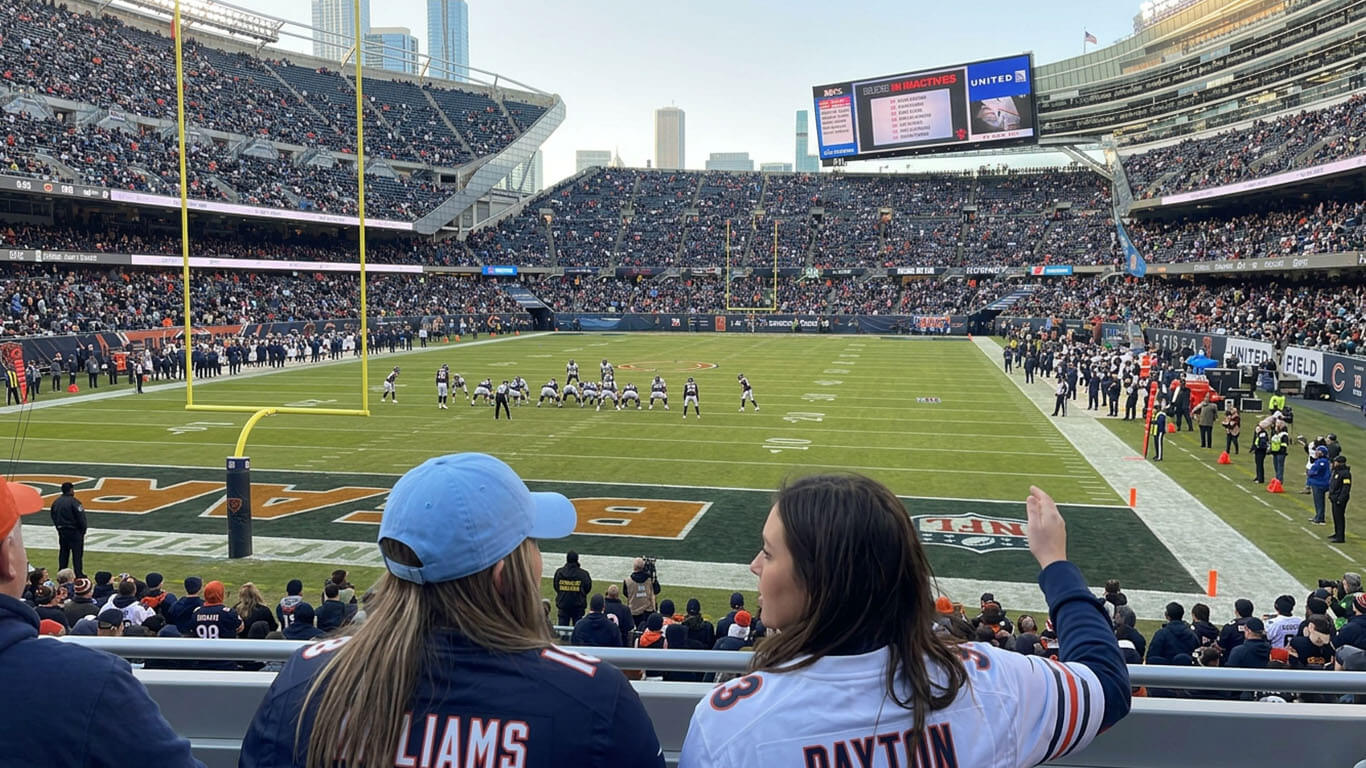
Soldier Field has a three-tier bowl wrapped around a natural-grass gridiron. The 100-level lower bowl wraps the gridiron, the 200-level United Club mid-tier sits on the east sideline, the 300-level upper tier includes both Upper Club inventory and standard upper bowl, and the 400-level grandstand crowns the top of the building. Capacity sits at roughly 61,500, which is the smallest in the NFL, and that compression changes the value math on every ticket compared to bigger venues. The home bench is on the west sideline in front of the lower 130s range, and the visiting bench is across on the east in front of the 107-111 range. Lake Michigan sits directly east of the building, which means cold wind hits the east sideline first in late autumn and into December. Read the breakdowns below as a hierarchy of choice rather than a simple ranking, since the right pick depends on the matchup, the month, and the kind of weekend and packages you are building around the game.
Lower Bowl Sideline (107-115 and 130-144)
Lower sideline seats run between the 20-yard lines on both sides of the gridiron and give travelers the closest sustained read on offensive formations, route concepts, and the small adjustments that decide an NFL game. The 130-144 range sits on the home side behind the team bench, which means you watch the home offense through the back of the team area but pick up real-time sideline reactions, coaching adjustments, and personnel groupings as they happen. The 107-115 range on the visiting side gives you a cleaner front-on view of the home offense when they have the ball, since you are looking directly at the Bears as they break the huddle and set the formation. Rows 15 through 25 in either location are the sweet spot because you sit above the player tunnel and the photographer line but stay close enough to hear pads connect on goal-line stands. Below row 10, sightlines to the opposite side can get blocked during huddles by the standing personnel along your own side.
The lower side is the priciest non-suite category in the building, and the cost reflects both the view and the demand profile. Sideline pricing typically runs $250 to $550 for non-marquee matchups, and divisional weekends against the Packers, Vikings, and Lions can push the same tickets past $800. The honest tradeoff is weather. The lower bowl at the venue has zero overhang protection, so wind, rain, and late-November cold come at you directly with no relief. For a September or early-October Chicago trip where the forecast holds, the lower sideline is where I would spend the money, especially if the matchup is meaningful, the packages line up, and the rest of the trip is mild-weather. For a late-November or December trip with a sub-freezing forecast, I would honestly look at the 200-level lounge instead, because the comfort gap between open-air lower seats and a heated lounge is larger than most ticket guides admit.
Lower Bowl Corner and End Zone (101-106, 116-129, 145-155)
Lower bowl corners and end zones at Soldier Field are the strongest pure-value play in the 100 level, and they get overlooked by travelers who default to midfield without thinking through the geometry. The 116-129 range wraps the south corner and goal-line area, the 145-155 range wraps the north corner and end zone, and the 101-106 sections together with the high 100s wrap toward the corners on either side. From rows 8 through 18 in any of these positions, you get a depth-perception view of red-zone offense, goal-line defense, and fade routes that you simply cannot get from a midfield sideline. The angle is real, and tracking plays developing on the far end of the gridiron requires more head movement, but the up-close payoff on touchdowns scored in front of you is the kind of memory that makes a Chicago Bears trip worth the travel.
Lower corner tickets typically run 30 to 40 percent less than midfield sideline pricing, which is significant when you are building a trip that also includes downtown hotels and travel. The south end zone seats behind 101-106 also tend to attract the most engaged season ticket holder base, and the noise compounds on third-down stops and red-zone defenses. Avoid the absolute front rows in the corners, since the wrap-around wall, photographer well, and sideline personnel block sightlines to the near hash. Lake wind hits the north end zone harder than the south on most game days, so if you are weighing a December game and the price is similar between the two corners, lean toward the south side. Families looking to sit together in the lower bowl can usually land four seats in these areas under $600 on non-marquee Chicago Bears tickets, which is hard to match in the rest of the venue when you compare similar packages.
United Club 200 Level (202-216)
The 200-level United Club is the section that surprises travelers the most, because the chart positions it above the lower bowl yet the real-world value often beats both the 100-level lower bowl and the 300-level upper inventory once weather enters the equation. The 202-216 range runs along the east sideline at mid-bowl elevation, with rows 14 and above sitting under overhang protection from rain, snow, and most of the lakefront wind. All the seats are padded, the climate-controlled indoor lounge opens roughly two hours before kickoff and stays open about five hours after, and in-seat wait service brings food and drinks to your row. The 208-211 range sits closest to the 50-yard line and is the strongest single block of seats in the 200-level Club for football-first travelers building Chicago Bears trips.
Premium tickets on the 200 level price in the $400 to $700 range per seat for most home matchups, and divisional weekends can push the top of that range significantly higher. The case for paying the premium is straightforward on a late-season trip, since the lounge gives you indoor warmth between quarters, a real meal instead of concourse food, and private restrooms with no line. For an early-season matchup where the forecast is mild, the value case is weaker because you are paying for amenities you would not otherwise use. Skip the 200-level Club if your priority is raw crowd energy, because the indoor lounge pulls people out of their seats during commercial breaks. Buy it if you are bringing a client to a Chicago Bears game, hosting parents on a one-game-a-year Chicago weekend or bundling premium packages, or attending a December game where the wind chill is forecast to hit the teens.
Upper United Club 300 Level (301-317)
Most guides overrate the standard 300-level upper bowl and underrate the 300-level lounge extension in the 301-317 range. Here is what actually happens once you are sitting there on game day at Soldier Field. The same indoor lounge, the same in-seat wait service, the same padded seats, and the same private entrance you get on the 200-level Club carry up to the 300-level Club inventory, and pricing typically runs 25 to 35 percent below the 200-level equivalent. The angle is steeper, which actually helps you read offensive formations and defensive coverage shifts in a way midfield ground-level seats cannot. Most travelers will not notice the gap on most matchups, and the value compresses further on weather-vulnerable late-season games.
If you can land 300-level Club tickets in the $300 to $450 range, that is the sweet spot of the entire pricing curve at Soldier Field, and it rarely shows up in the same way at peer NFL venues. Solo travelers who want the heated lounge without paying the 200-level premium should set alerts on these tickets specifically and watch the resale market and the active travel packages four to seven days out from kickoff. Late-week resale on the 300-level Club tends to be thinner than the 200-level Club because the season ticket holder base is smaller, so the inventory window closes earlier. Travelers booking Chicago Bears trips through one consolidated planning tool, with downtown hotels and travel locked first and tickets layered on once the section is right, often land here.
Upper Deck 400 Level (401-447)
The 400 level is the cheapest way into a Chicago Bears game, and the value-per-dollar math is genuinely strong in the right rows. The 401-415 range sits on the east-sideline upper, the 432-442 range sits on the west-sideline upper directly above the home bench area, and the corner and end-zone sections in the 415-431 and 442-447 ranges wrap the rest of the upper bowl. Because this is the smallest stadium in the NFL, even the 400 level does not feel as distant as the equivalent upper rows in a 70,000-capacity venue. The elevation gives you a full-bowl perspective on play development, defensive rotations, and special-teams coverage lanes, which is genuinely the part of football that benefits most from altitude. Rows 1 through 12 in the 432-442 west-sideline range are the cleanest read in the building for the price.
Upper deck Chicago Bears tickets typically list in the $60 to $120 range for non-marquee matchups, which is real money saved versus the rest of the building. The honest tradeoffs are wind exposure, the climb, and zero overhang. The 400 level catches lakefront wind harder than any other category at Soldier Field, the stairs from the concourse to the back rows are a workout, and you will be exposed to whatever weather rolls in during the game. For September and early October dates, this is where I would spend the savings on better Chicago hotels, packages add-ons, and a real dinner in the West Loop. For late-November and December trips, the savings are not worth what you give up in comfort. The east-sideline 401-415 upper also loses sun exposure by halftime on afternoon kickoffs, so if you sit here in cold weather, the west 432-442 range is the better pick.
Premium Suites and Loge Boxes
Soldier Field has a smaller premium-product menu than newer NFL venues, but the three tiers that exist work well for the right groups. Executive Suites on the C Level and Skyline Suites on the SC Level run along the east sideline above the United Club, with single-game pricing typically in the $15,000 to $40,000 range per game depending on opponent, suite size, and inventory channel. Most single-game suite inventory moves through corporate channels or the Bears organization directly rather than the standard secondary resale market, so plan that path early if a suite is on the table for your Chicago trip. Loge Boxes are the most underrated premium product in the building, with four-to-twelve-guest spaces, a private bar, in-seat wait service, and an intimate alternative to a full suite. Loge pricing typically runs $1,200 to $2,500 per box per game, which works out to a reasonable per-guest rate at full capacity once you factor the food and beverage credit. They are a strong fit for corporate hosting, milestone weekends, custom packages, and small-group Chicago Bears travel.
Chicago Bears Tickets Strategy: When and How to Buy
Chicago Bears tickets follow a release-and-decay curve that travelers can use to their advantage if they understand the rhythm. Single-game tickets typically go on sale in mid-July after the NFL schedule release, with the cleanest pricing window for non-marquee Chicago Bears games landing between August and the first week of September. After the home opener, prices and packages drop on the soft matchups (early-season AFC opponents, late-season dates against non-contenders in cold-weather slots) as season ticket holders unload inventory they cannot use. Divisional matchups against the Packers, Vikings, and Lions hold or appreciate through the year, and primetime broadcasts barely move from their release prices. Lock those into Chicago Bears Travel Packages with downtown hotels early if any of them are on your shortlist.
The timing rule for everything else is simple. Book tickets for non-divisional matchups inside the four-week window before kickoff, since that is when secondary market sellers start cutting prices to clear inventory before the resale fee schedule shifts. The exception runs in the opposite direction for Packers, Vikings, Lions, and any Sunday or Monday night game on national television, where the right move is to lock the tickets and packages within three weeks of the May schedule release. There is also a Tuesday-Wednesday cycle in the week of the game itself when secondary listings often see one final price drop before sellers commit to absorbing the loss, and that window tends to matter most for the Club inventory and the upper sideline.
Matchup tiering also drives Chicago travel and downtown hotel pricing in ways that ticket-only guides miss. Packers week is the priciest single weekend on the calendar, and downtown hotels near the lakefront tighten well in advance, so the Chicago Bears trip needs to be booked as a whole rather than piece by piece. Vikings and Lions weekends sit just behind. Mid-tier matchups against the Panthers, Jaguars, or weather-vulnerable late-season opponents are where Chicago Bears Travel Packages deliver the cleanest value, because downtown Chicago hotels soften at the same time tickets soften. Groups of four or more should book the packages six weeks out for divisional games and four weeks out for everything else, especially if specific sections matter to the group.
The counterintuitive tactic worth knowing is the weather-window release at Soldier Field. Tickets for late-November and December games against non-contending opponents often see meaningful price drops in the 48 to 72 hours before kickoff when long-range forecasts call for sub-freezing temperatures or steady rain off the lakefront. Some season ticket holders unload inventory rather than sit through it, and travelers willing to bring layered cold-weather gear can stack value this way. This tactic does not work for Packers, Vikings, or primetime Chicago Bears games, which never see late inventory, but it works repeatedly for mid-tier matchups. Bundling tickets with hotels in the Loop through Chicago Bears Tickets and Hotel Packages consolidates the planning into one view and removes the timing mismatch between when tickets and Chicago hotels each hit their best price.
How Ticket Type and Location Impact Value at Soldier Field
The value math on Chicago Bears tickets does not follow the seating chart in a straight line, which is the most useful thing this guide can teach a traveler planning a Chicago trip. The lower sideline looks like the obvious premium, and it is in September. In December, it is not, because the wind chill at the lakefront can render the same tickets significantly less enjoyable than 200-level Club seats at $50 to $100 more per ticket. The 300-level Club inventory is genuinely the strongest value tier in the building once you are weighing comfort, sightlines, price, and travel packages together. The 400-level upper deck is the budget call in mild weather and a tough sit at Soldier Field in cold weather, and the corners in the lower bowl quietly outperform on goal-line geometry. None of that comes through clearly on a static seating chart, which is why the right tickets depend on the matchup, the month, and the rest of the Chicago Bears trip you are building.
Location at the venue also drives how the rest of the Chicago trip flows. Lower bowl east sideline tickets (107-115) put you closest to the McCormick gate and the Museum Campus exit toward downtown, which matters if you are heading back to a Loop hotel after the game. West sideline tickets (130-144) put you closer to the gates feeding back to the south parking and the rideshare zones along Lake Shore Drive. The 200-level lounge entrance funnels through a private gate that bypasses the general concourse entirely, which saves real minutes on entry and exit for travelers on tight game-weekend itineraries. These small flow details rarely show up in ticket reviews or packages comparisons online, but they shape the actual experience of attending a Soldier Field event in person and they are the kind of detail Chicago Bears Travel Packages buyers ask about most often.
Plan Your Chicago Bears Trip with Tickets and Hotel Together
Planning a Chicago Bears travel itinerary the right way means treating tickets, downtown Chicago hotels, and travel as a single coordinated decision and packages framework rather than three separate purchases that happen to involve the same weekend. The downtown hotel market for Chicago Bears weekends moves on a different curve than the ticket and packages market, and trying to optimize one without the other usually means giving up value on whichever piece you book last. Loop and South Loop hotels near the venue fill up first for Packers and Lions weekends, with rate gaps between an eight-week-out booking and a two-week-out booking running two to three hundred dollars per night on premium properties. Tickets often move in the opposite direction on non-divisional games, softening in the final week as season ticket holders clear inventory.
Elite Sports Tours is a sports travel platform that pulls Chicago Bears tickets, downtown Chicago hotels, and optional flights into one comparison view so travelers can build the Chicago Bears trip to Soldier Field in one place rather than running three separate searches across resale sites and travel aggregators. The travel packages model removes the timing mismatch and packages confusion that makes piecing trips together yourself painful, and it also catches conflicts early (flights that miss kickoff, hotels without the parking access you need, tickets in sections that conflict with the rest of the itinerary). For a single home weekend or a multi-game NFL road-trip itinerary built around the team, the consolidated approach saves both money and planning time. The platform is built specifically for sports travel rather than adapted from a generic booking engine, and that focus shows up in the inventory mix.
For travelers who want a full-service approach to the Chicago Bears trip, the Elite Sports Tours team also builds custom Chicago Bears Travel Packages - Tickets, Flights and Hotels for individuals, couples, groups, corporate hosting, and milestone weekends. Group blocks of ten or more tickets and matching packages, divisional rivalry weekends against Green Bay or Detroit, and primetime broadcast travel are the most common custom-package requests, and the team handles ticket coordination, packages structuring, downtown hotel block negotiation in the Loop or Museum Campus area, and ground logistics. Whether you book individual pieces of the trip through the platform or work with the travel team on a custom Chicago Bears travel package, the goal stays the same. Every part of the Chicago Bears travel itinerary lines up around the same kickoff at Soldier Field without planning friction eating the weekend.
Chicago Bears Tickets FAQ
What are the best Chicago Bears tickets at Soldier Field?
For pure football reading, lower sideline tickets in the 107-115 and 130-144 range, specifically rows 15 through 25, deliver the cleanest sustained view of play development. For comfort and cold-weather protection, the 200-level United Club is the most consistent four-quarter setup with indoor lounge access, in-seat wait service, padded seating, and a private entrance. For value, the 300-level Club inventory offers the same lounge access at 25 to 35 percent below the 200-level price, which makes it the strongest value pick and packages anchor in the building. For budget travelers, the 432-442 west-sideline upper deck wins the price-to-view math while keeping slight wind protection. Match the section to the priority that drives the trip rather than choosing by chart position alone.
What are the best value sections at Soldier Field for Chicago Bears games?
The 300-level Club is genuinely the best-value Chicago Bears tickets category in the building when you weigh comfort, sightlines, and price together, with the same lounge access as the 200-level Club at significantly lower pricing. Lower corner tickets in the 116-129 range or the 145-155 range are the strongest value play in the 100 level for travelers who want lower bowl proximity at non-premium prices. The 432-442 west-sideline upper deck is the budget winner for travelers who can read the game from elevation and do not mind the climb. The corner sections on the 400 level, 415-431 and 442-447, deliver the absolute lowest ticket pricing but give up too much on sightlines to recommend unless price is the only variable for the trip.
Are premium Chicago Bears tickets worth it?
For late-season games at the venue, premium tickets are absolutely worth the spend because the lakefront cold and wind make the open-air bowl genuinely uncomfortable from mid-November onward. The 200-level United Club, with its indoor lounge, in-seat wait service, climate-controlled space, and overhang protection, transforms a December Chicago Bears weekend from an endurance test into a comfortable weekend. For early-season games in mild weather, the value case for premium tickets weakens because you are paying for amenities you would not otherwise need. Loge Boxes are the right premium pick for groups of four to twelve who want all-inclusive catering with a private bar, and the per-guest math at full capacity often beats a comparable block of Club tickets once the food and beverage credit is included.
How does weather impact Chicago Bears tickets at Soldier Field?
Weather reshapes the value of tickets at Soldier Field more than at any other open-air NFL building, because the lakefront wind and the open-air bowl combine to make late-season games genuinely punishing. From early November through the end of the regular season, the 200-level and 300-level Club inventory becomes meaningfully more valuable relative to the lower bowl. Wind chill in the teens or single digits on a December afternoon is common, and the lake effect can add a steady twenty-mile-per-hour wind on top of the temperature. The east-sideline upper at the building catches the lakefront wind first, so west-sideline tickets on cold days carry a slight comfort edge. Weather-vulnerable late-season Chicago Bears games are also where mid-week resale price drops show up most reliably, which is useful for travelers willing to flex their seating choice in the final week.
Can I bundle Chicago Bears tickets with hotels for Soldier Field weekends?
Yes, and bundling tickets with downtown Chicago hotels for home weekends is genuinely the better path for most travelers planning a Chicago Bears trip. The travel packages model pulls tickets, downtown hotels near the venue, and optional flights into a single comparison view, which removes the timing mismatch that makes piecing trips together yourself stressful. Elite Sports Tours builds Chicago Bears Travel Packages for individuals, couples, groups, corporate hosting, and milestone weekends, with group blocks for ten or more tickets handled through the custom packages team. Divisional weekends against Green Bay, Minnesota, or Detroit are the most common Chicago Bears Travel Packages requests because hotels and tickets both tighten in advance for those weekends, and bundled travel locks both pieces at once.
Are stadium tours included with Chicago Bears tickets?
No, stadium tours are a separate booking from game tickets and are operated independently from Chicago Bears game-day events at the venue. Chicago Bears Travel Packages from Elite Sports Tours include tickets, downtown Chicago hotels, and travel coordination, but stadium tours are not bundled into the standard packages and would need to be added separately when available. For travelers who want a behind-the-scenes look at the building, tour availability fluctuates by season and is best confirmed directly with the Chicago Park District or the stadium operations team closer to the trip date. Tour content has historically included ground-level access, the Doughboy statue area, the Cadillac Club lounge, locker room areas when scheduling allows, and the press box. Single-tour pricing is modest compared to game day, but bookings can get tight during peak summer months, so add the tour to the planning list early if it is part of the Chicago Bears trip and not part of the standard packages bundle.
Did You Know: Why is Soldier Field called Soldier Field?
Soldier Field opened in 1924 and was originally named Municipal Grant Park Stadium, with the name changed to Soldier Field in 1925 to honor American soldiers who died in combat. The South Park Commissioners voted on the rename to dedicate the building as a memorial to the fallen of World War I and prior American military conflicts, and the colonnaded Doric design was deliberately chosen to evoke classical war-memorial architecture. The building has hosted Army-Navy football, multiple boxing world championships including the 1927 Dempsey-Tunney rematch, papal masses, and decades of Chicago Bears football since the team moved in for the 1971 season. A major interior renovation completed in 2003 rebuilt the bowl inside the historic colonnaded facade, and that work reduced capacity to roughly 61,500, the lowest in the NFL today. The Chicago Bears have been the primary tenant for over five decades, making the venue the longest-running home in the franchise's history.
Explore More Chicago Bears Travel Guides
Planning a trip to see the Chicago Bears involves more than just buying tickets. Hotel location, access, seating strategy, and transportation timing can all impact your overall game-day. These guides help break down each part of the planning process so you can compare tickets, hotels, and travel options more efficiently.
- Chicago Bears Travel Guide for Fans: Build a complete Chicago Bears travel plan with insights on how to structure your trip around a game.
- Best Hotels Near Soldier Field for Chicago Bears Games: Compare the top hotel areas near Soldier Field, including Downtown Chicago, the Loop, and South Loop options commonly used in Chicago Bears Travel Packages.
- How to Get to Soldier Field for Chicago Bears Games: Learn the best driving routes, parking options, CTA access points, rideshare zones, and game-day transportation strategies around Soldier Field.
- Best Seats and Ticket Options at Chicago Bears Games: Section-by-section breakdown of seating views, premium areas, lower bowl options, club seats, and ticket strategies for Bears games.
- Where the Chicago Bears Stay on the Road: Explore known team hotel patterns and travel insights for fans planning Chicago Bears away-game trips.
- Chicago Bears Stadium Tours at Soldier Field: Learn what is included on Soldier Field tours, including locker room areas, and behind-the-scenes experiences.
- Chicago Bears Travel Packages: Explore complete Chicago Bears Travel Packages that include tickets, hotels and optional flights for your next game.
Editorial Note and Travel Expertise
This Chicago Bears seating guide reflects years of in-person visits to Soldier Field across multiple seasons and matchup types, including divisional Packers and Vikings weekends, primetime broadcast kickoffs, mid-tier Sunday afternoon dates, and late-season December games in genuinely punishing lakefront weather. The recommendations come from sitting in the lower sideline, the lower corners, both 200-level and 300-level Club inventory, the upper deck on both sidelines, and a Loge Box during a corporate hosting weekend. Soldier Field is a unique NFL building because of the open lakefront exposure, the historic colonnaded facade, the compressed capacity, and the three-tier bowl, and seat selection at Soldier genuinely matters more than at almost any other stadium in the league. The wrong section in November can flip an otherwise well-built Chicago Bears trip.
Seat selection at the venue also connects directly to the rest of the Chicago trip, which is why this guide treats tickets, downtown hotels, and lakefront travel logistics as a single planning decision rather than three separate ones. The recommendations are reviewed and maintained by the Chicago-based Elite Sports Tours team to reflect current section numbers, premium product naming, current packages, and matchup pricing patterns, including the ongoing new-stadium conversation between Arlington Heights, Hammond, and the existing lakefront site. Use the FAQ for quick decisions on common questions, use the section breakdowns and packages comparison for in-depth research, and use the Chicago Bears Travel Packages link when you are ready to coordinate tickets, Chicago hotels, and travel in one booking. The home venue named after fallen American Soldier memorials rewards travelers who pick their seats with intention, especially as the building's NFL future remains an open question.
Travel Information Disclaimer
Ticket availability, pricing, premium product access, and section configurations at Soldier Field can change throughout the NFL season based on demand, opponent, broadcast windows, and operational decisions by the Bears or Soldier Field management. Premium products and packages including United Club inventory, Loge Boxes, Executive Suites, and Skyline Suites may adjust in pricing, inclusions, or access policies depending on the matchup and the inventory channel. The recommendations in this guide reflect section numbers, packages, and pricing patterns as of the publication date, and the Elite Sports Tours team updates the guide periodically to keep the information accurate. The new-stadium conversation between Arlington Heights, Hammond, and the existing lakefront site is also ongoing and may affect future season planning.
Hotel pricing throughout the Loop, South Loop, Museum Campus corridor, and lakefront can shift significantly during home weekends, conventions at McCormick Place, holiday events, and major concerts. Parking operations near the venue, rideshare access points along Lake Shore Drive, pedestrian routing through Museum Campus, and stadium entry procedures may also change depending on attendance levels and security planning. Confirm current ticket details, current downtown hotel policies, parking and rideshare information, and kickoff timing closer to the trip date for the most accurate travel planning. Travel package availability and inclusions are subject to change based on ticket supply, hotel availability, and operational logistics on a given weekend.
Updated May 2026