

How to Get to AT&T Stadium for Dallas Cowboys Games
How to Get to AT&T Stadium for Dallas Cowboys Games is a complete transportation guide that explains how fans reach the stadium from Dallas, Fort Worth, and surrounding areas using driving routes, parking zones, and limited public transit options. Access is primarily structured around game-day traffic flow, pre-paid parking, and rideshare coordination, with timing playing a key role in arrival and exit. This guide also shows how to align transportation with tickets, hotels, and complete Dallas Cowboys travel packages for a coordinated trip.
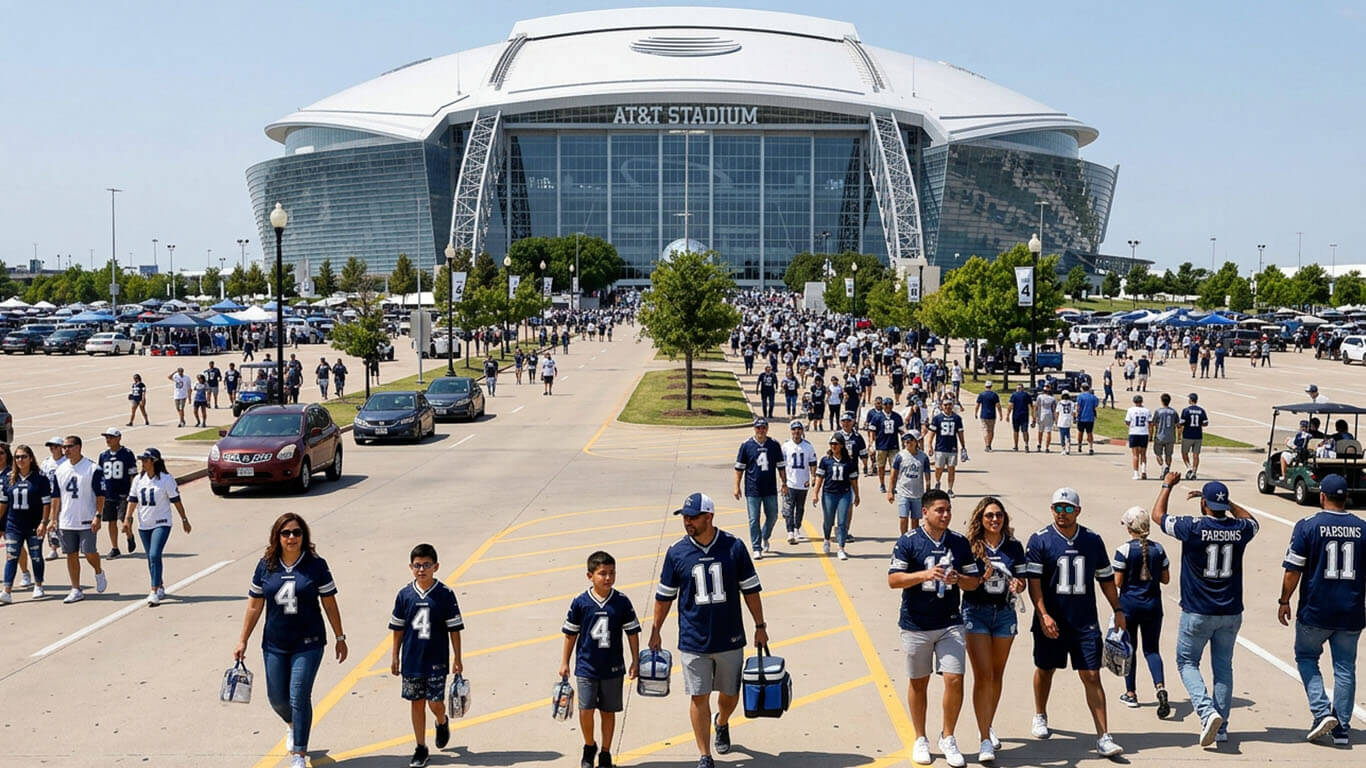
How to Get to AT&T Stadium for Dallas Cowboys Games
Planning how to get to AT&T Stadium is one of the most important parts of the overall travel experience. The venue sits in Arlington between Dallas and Fort Worth, which means most fans flying in or driving from a hotel are not walking out the front door and arriving at the gates. The geography of the area creates real choices around airports, parking, rideshare, and limited transit, and the way those pieces fit together has a direct impact on how a Dallas Cowboys game day actually feels. Getting this part of the trip right is what allows the rest of the Dallas Cowboys weekend to land cleanly.
AT&T Stadium is located at 1 AT&T Way in Arlington, roughly 20 miles west of downtown and about 15 miles east of downtown Fort Worth. It is reachable from I-30 via the Collins Street and Ballpark Way exits, from State Highway 360 via Division Street, and from a network of feeder roads built specifically to handle Dallas Cowboys traffic. Unlike NFL stadiums embedded into a downtown core, AT&T Stadium is a destination venue in the Dallas area surrounded by parking lots, the Texas Live entertainment district, and Globe Life Field next door. That setup creates flexibility for fans because every approach route handles a different pocket of travel demand, but it also means planning matters more than it would for a venue with a single transit station outside the gates.
The right way to approach travel also depends on where the hotel is. A hotel inside the Arlington Entertainment District puts AT&T Stadium within walking distance, which changes the entire calculation around parking and rideshare. A hotel in downtown Dallas puts the building 20 miles east, which favors driving or a pre-arranged shuttle. A Fort Worth hotel sits about 15 miles west, which favors I-30 and tends to clear faster after the game. Each of those starting points produces a different best answer, and that is why the question of how to get to AT&T Stadium is really a question about the full DallasCowboys trip. You can simplify things by bundling Flights, Hotels and Tickets with Dallas Cowboys Travel Packages.
Flying to Dallas for a Cowboys Game, Airport Information
Most travel begins at Dallas Fort Worth International Airport, which is the primary airport for the region and the closer of the two options to AT&T Stadium. DFW sits about 12 miles north of the venue, and the drive typically runs 20 to 25 minutes outside of game traffic. DFW is one of the largest airports in the country, served by American Airlines as a major hub, along with United, Delta, Southwest, JetBlue, Alaska, and most major international carriers. For fans coming from outside Texas, DFW is almost always the right answer because flight options are deep across nearly every U.S. market and connection times into Arlington are short.
Dallas Love Field is the secondary airport for the area and sits closer to downtown Dallas, roughly 20 miles east of AT&T Stadium. Love Field is dominated by Southwest Airlines and offers a smaller but still useful flight network, particularly for Dallas Cowboys travelers coming from cities Southwest serves heavily. The drive from Love Field to Arlington runs about 25 to 30 minutes outside of traffic, and the airport tends to feel quicker on arrival because the terminal footprint is smaller. Love Field works best for fans staying in downtown Dallas hotels, since the airport drive lines up with the same I-30 route used to reach the building on game day.
The choice between the two airports usually comes down to flight network and hotel location rather than distance to AT&T Stadium. DFW gives more direct flight options, longer hours of operation, and better fit for fans staying in Arlington, Las Colinas, or anywhere on the western side of the Dallas Fort Worth metroplex. Love Field is faster on the ground for fans on Southwest and tends to align better with downtown Dallas hotels. For most travel plans, DFW is the default unless the flight schedule or hotel decision pushes the trip toward Love Field.
Either airport produces a workable Dallas Cowboys trip, and travel time on game day is usually similar by car. The bigger factor is what the airport choice does to the rest of the weekend. Travelers who plan to spend time in downtown Dallas before or after the game often choose Love Field for the shorter ride to the city, while travelers who want to be near AT&T Stadium and spend most of their time around the Arlington Entertainment District typically choose DFW.
Driving and Parking at AT&T Stadium for Cowboys Games
Driving is the most common way Dallas fans get to AT&T Stadium because the venue was designed for large-scale parking. There are approximately 12,000 parking spaces distributed across 15 numbered lots on the AT&T Stadium grounds, with additional thousands of spaces available in the lettered lots around Globe Life Field next door that can be used on Dallas Cowboys event days. Parking lots open five hours before kickoff for most regular-season Dallas Cowboys home games, which gives fans a long runway to settle in, tailgate, and walk over to the gates without rushing.
Parking pricing at AT&T Stadium varies by lot and by Dallas Cowboys opponent. Most general lots run roughly 60 to 100 dollars per vehicle for standard regular-season games, with closer-in preferred lots running higher. Divisional games against the Eagles, Giants, and Commanders, along with primetime home games, push pricing higher, and lots closest to the gates fill earliest. Pre-purchasing a parking pass through the official Cowboys parking system is recommended for any high-demand game, because it locks in a specific lot assignment, removes the need to negotiate at the gate, and shortens entry time on arrival.
Tailgating is a defining part of the game day environment, and AT&T Stadium handles it through designated tailgating spaces on the perimeter of specific lots. Tailgating spaces are available in Lots 4, 5, 6, 7, 10, 11, 12, 13, 14, and 15, each with a grassy area immediately behind the vehicle so fans can set up grills, chairs, and tents without blocking traffic lanes. Tailgating spaces are first come, first served, so fans planning to host a setup typically arrive close to the five-hour gate opening to lock in position.
The exit from AT&T Stadium is the part of the Cowboys driving plan that catches first-time visitors off guard. With 12,000 vehicles funneling out of the lots and onto Collins Street, Randol Mill Road, and the I-30 ramps at the same time, the lots near the gates can take 45 minutes to an hour to fully clear after a game. The fastest way to reduce that exit time is either to stay 20 to 30 minutes after the final whistle and let the heaviest wave clear, or to choose a lot farther from the gates that empties onto a less congested street. Lots on the south and east side of the AT&T Stadium footprint tend to clear faster than the lots immediately west of the building.
Driving still gives fans the most flexibility, especially for trips that extend beyond the game itself. A car makes it easier to combine the Dallas Cowboys trip with a stop at Texas Live, a visit to Globe Life Field, dinner in Fort Worth, or a return to a hotel that is not within walking distance of the venue. For weekends that include multiple stops across the Dallas Fort Worth metroplex, driving is almost always the most reliable way to manage time around AT&T Stadium without depending on anyone else's schedule.
Public Transit to AT&T Stadium for Cowboys Games
Public transit is the weakest link in Cowboys travel because Arlington is one of the largest U.S. cities without a comprehensive public transit system. There is no DART light rail station at AT&T Stadium, no commuter rail line that drops directly at the gates, and no continuous bus service from downtown Dallas to the building. Dallas fans relying on transit need to plan a multi-leg route that combines rail with a connecting shuttle or rideshare for the final stretch into Arlington, and the total transit travel time is usually longer than driving even on a heavy traffic day.
The most workable transit option is the Trinity Railway Express, which runs between Dallas Union Station and downtown Fort Worth and stops at the CentrePort/DFW Station. From CentrePort, Cowboys fans typically connect to a rideshare or a private shuttle for the final 10-mile leg into Arlington and AT&T Stadium from downtown Dallas. The TRE runs limited service on Sundays, which lines up with most regular-season Dallas Cowboys home games, but riders should always confirm the day-of schedule because frequency is lower than weekday service.
Arlington also operates the Via on-demand transit service, which can be booked through an app for short trips inside the city, though Cowboys game day demand and limited capacity make it less reliable as a primary plan for getting to AT&T Stadium. Some Dallas Cowboys fans staying in downtown Dallas use a private shuttle or charter bus service that runs from hotels directly to AT&T and back, which removes the multi-leg transit problem and effectively functions as a hotel-based transit alternative. Pricing for those services typically runs 30 to 60 dollars round trip per person depending on the operator and the Cowboys opponent.
Public transit works for some Dallas Cowboys travel plans, but only when the hotel location aligns with the rail route or when a private shuttle is built into the trip. For most fans, the absence of direct transit to AT&T Stadium pushes the plan toward driving or rideshare instead. The lack of public transit is the single biggest reason that hotel location and parking strategy matter more for games than they do for many other NFL trips.
Rideshare to AT&T Stadium for Cowboys Games
Uber and Lyft both operate throughout the Dallas Fort Worth area and serve AT&T with a designated rideshare zone in Lot 15, accessed off Randol Mill Road and Web Street. The Lot 15 rideshare zone is the official drop-off and pickup location for Cowboys games, and entering Lot 15 directly into Uber or Lyft routes the driver to the correct part of the AT&T footprint. Some Cowboys fans are also dropped off in Lot 1 off Randol Mill Road or Lot 6 off Cowboys Way for pre-game arrival, though Lot 15 is the primary and most reliable rideshare zone.
Arrival by rideshare is usually straightforward in the hours leading up to a Dallas Cowboys game. Demand from downtown Dallas, Fort Worth, and the surrounding hotel areas is steady but spread out across a long pre-game window, so wait times tend to stay manageable and routes flow well outside of the final 30 minutes before kickoff. Pricing from downtown Dallas to AT&T Stadium typically runs 25 to 50 dollars depending on the time of day and Cowboys opponent, while rides from DFW Airport tend to land in the 30 to 45 dollar range without surge.
Post-game rideshare is where Dallas Cowboys fans run into trouble. The combination of 80,000 fans leaving AT&T Stadium at once, limited road capacity around the lots, and concentrated demand into Uber and Lyft creates significant surge pricing in the first 30 to 45 minutes after the final whistle. Walking 10 to 15 minutes away from the AT&T Stadium gates toward Division Street or Collins Street north of the venue can drop pricing meaningfully and shorten the wait, because drivers find it easier to reach those pickup points than the lots immediately around the building.
Rideshare works best for Cowboys travel plans that prioritize simplicity and skip the parking decision entirely. Uber and Lyft handle the arrival cleanly and remove the need to manage a tailgate setup or a 12,000-vehicle exit, but the demand pattern before and after Dallas Cowboys home games is uneven and pricing can swing significantly. Building 15 to 20 minutes of post-game flexibility into the plan is the difference between an easy ride home and a frustrating one.
Did You Know: AT&T Stadium
AT&T Stadium opened on May 27, 2009 as Cowboys Stadium, replacing the partially covered Texas Stadium in Irving that had served as the Dallas Cowboys home from 1971 through the 2008 season. The new building was developed by Dallas Cowboys owner Jerry Jones, designed by Dallas-based HKS Architects, and built by Manhattan Construction at a total cost of roughly 1.2 billion dollars. The first regular-season Dallas Cowboys game in the building was played on September 20, 2009, and the building drew an attendance of more than 105,000 that night, breaking the NFL regular-season attendance record at the time.
The Cowboys Stadium name held for four years before naming rights were sold. On July 25, 2013, Jerry Jones announced a long-term naming rights deal with Dallas-based AT&T, and the building was renamed AT&T Stadium that same year. Reported financial terms placed the deal in the range of 17 to 19 million dollars per year. AT&T has hosted Super Bowl XLV in February 2011, the 2010 NBA All-Star Game, the 2014 NCAA Men's Final Four, multiple Cotton Bowl Classics, the Big 12 Football Championship Game, several major boxing cards, WrestleMania 32, and a long list of concerts at the venue. The building is also one of the U.S. venues selected to host matches during the 2026 FIFA World Cup, where it will be referenced as Dallas Stadium under the tournament's non-commercial naming rules.
The venue sits in Arlington at the intersection of Randol Mill Road and Collins Street, a location chosen specifically to handle the Dallas Cowboys parking footprint and to position the building between downtown Dallas and Fort Worth. The setting allowed for the 12,000-space parking system and the surrounding entertainment district that has since grown around the Dallas venue, including Globe Life Field, Texas Live, and the Loews Arlington Hotel. That geographic positioning is also the reason Dallas Cowboys travel relies so heavily on driving and rideshare instead of public transit. The site was built with cars in mind from the beginning.
Plan Your Cowboys Trip With Elite Sports Tours
At Elite Sports Tours, planning how to get to AT&T Stadium is built into the structure of the trip from the beginning. Hotel location, arrival timing, walkability, transit access, and parking strategy all affect how smooth a Dallas Cowboys weekend feels once you land. Instead of leaving those decisions to the last minute, we help travelers line up the pieces in a way that reduces friction and protects the quality of the overall trip.
This matters most for out-of-town visitors who are flying in, checking into a hotel, and trying to judge whether public transit, rideshare, or parking is the better fit for their schedule. The right choice depends on where you stay, when you arrive, and how much flexibility you want before and after kickoff. When those details are planned properly, the entire Dallas Cowboys experience feels easier and more controlled.
For fans looking to simplify the entire process, Dallas Cowboys Travel Packages combine game tickets, hotel accommodations in optimal locations, and a structured approach to getting to AT&T Stadium. This removes uncertainty and allows you to focus on the experience rather than the logistics.
Cowboys Transportation FAQ
What is the best way to get to AT&T Stadium for Cowboys games?
For most Dallas Cowboys fans, driving and parking on-site is the most efficient way to get to AT&T Stadium because the venue was built around 12,000 parking spaces across 15 lots. Rideshare through Uber or Lyft into Lot 15 is the next best option, especially for fans staying in downtown Dallas or near DFW. Public transit is limited and usually requires a multi-leg trip with a final shuttle or rideshare into Arlington.
How much is parking at AT&T Stadium?
Most general parking lots at AT&T Stadium run roughly 60 to 100 dollars per vehicle for regular-season Cowboys games, with preferred and closer-in lots priced higher. Divisional and primetime Dallas Cowboys games push pricing toward the top of that range and sell out earliest. Pre-purchasing a parking pass through the official Dallas Cowboys parking system is recommended for any high-demand game.
Is there public transit to AT&T Stadium?
There is no direct public transit to AT&T Stadium because Arlington does not operate a comprehensive transit system. The most workable option is the Trinity Railway Express to CentrePort/DFW Station, then a rideshare or shuttle for the final 10 miles into Arlington. Some Dallas Cowboys fans staying in downtown Dallas use a private shuttle directly from their hotel to AT&T Stadium instead.
Can you take Uber or Lyft to AT&T Stadium?
Yes. Uber and Lyft both serve AT&T Stadium with a designated rideshare zone in Lot 15, accessed off Randol Mill Road and Web Street. Pre-game rides flow well, while post-game pickups around AT&T Stadium often surge for 30 to 45 minutes. Walking 10 to 15 minutes away from the venue toward Division Street or Collins Street typically lowers wait time and pricing.
How early should you arrive at AT&T Stadium?
Parking lots open five hours before kickoff, and most Dallas Cowboys fans arrive two to three hours early to park, tailgate, and walk to the gates without rushing. Fans planning to tailgate in Lots 4 through 15 should arrive close to the five-hour gate opening to lock in a designated tailgating space. For high-demand Dallas Cowboys games, arriving earlier helps avoid the worst of the I-30 and Collins Street traffic.
Explore More Dallas Cowboys Travel Guides
Want to make the most of your NFL road trip? Be sure to check out these related guides for a seamless and memorable experience:
- Dallas Cowboys Travel Guide for Fans: Plan the perfect trip to catch a Dallas Cowboys game live at AT&T Stadium.
- How to Get to AT&T Stadium for Dallas Cowboys Games: Learn the best transportation options for getting to the game without hassle.
- Best Hotels Near AT&T Stadium for Dallas Cowboys Games Guide: Find the best hotels for Dallas Cowboys games when planning your sports trip.
- Where the Dallas Cowboys Stay on the Road Guide: Get insider information on where the Dallas Cowboys stay when they’re on the road and how you can book accommodations close to the action.
- Best Seats and Ticket Options at Dallas Cowboys Games Guide: Explore the best seating options at AT&T Stadium, from affordable seats to premium suites.
- AT&T Stadium Tours and Attractions Guide: Take an insider’s look at one of the NFL’s most iconic stadiums with exclusive tours and fan experiences.
- Dallas Cowboys Travel Packages: Explore complete travel packages, including tickets and hotels, for your next trip to see the Dallas Cowboys.
Editorial Note & Travel Expertise
This guide is based on real-world experience planning Dallas Cowboys travel and helping fans navigate AT&T Stadium across different types of trips. Every recommendation reflects how transportation, parking, and arrival timing actually work when attending Dallas Cowboys games, not just general directions or surface-level advice. AT&T Stadium is one of the more accessible stadiums in the NFL when approached with a plan, but the way you plan your arrival still has a direct impact on how smooth your day feels.
Dallas Cowboys travel often involves more than just getting to AT&T Stadium. Hotel location, flight timing, and transportation choices all connect, and small decisions can change how efficiently you move throughout the day. The goal of this guide is to provide practical, accurate information so you can build a plan that fits your schedule, avoids unnecessary delays, and allows you to focus on the Dallas Cowboys experience once you arrive.
Travel Information Disclaimer
Transportation routes, parking availability, and transit schedules for AT&T Stadium can change based on game-day operations, city planning, and demand. Parking prices, lot access, and shuttle availability may vary depending on the Dallas Cowboys schedule and attendance levels.
Public transit services, including the Trinity Railway Express, Via on-demand transit, and private shuttle operators, may adjust frequency or timing based on Dallas Cowboys schedules. Rideshare availability and wait times can fluctuate significantly before and after Dallas Cowboys games depending on demand. Travelers should confirm current transportation details, parking options, and timing closer to their travel date to ensure the most accurate planning around AT&T Stadium.
Updated May 2026


