Clemson Tigers Football Travel Guide
Clemson Tigers Football Travel Guide is your complete resource for planning a game day at Memorial Stadium in Clemson. Discover the best ways to get to campus, where to stay, how to find the best seats, and what to do before and after the game. Whether you're experiencing the iconic "Running Down the Hill" tradition for the first time or returning for another exciting ACC matchup, this guide covers tickets, hotels, travel tips, and complete Clemson Tigers travel packages to help you plan the ultimate college football weekend.
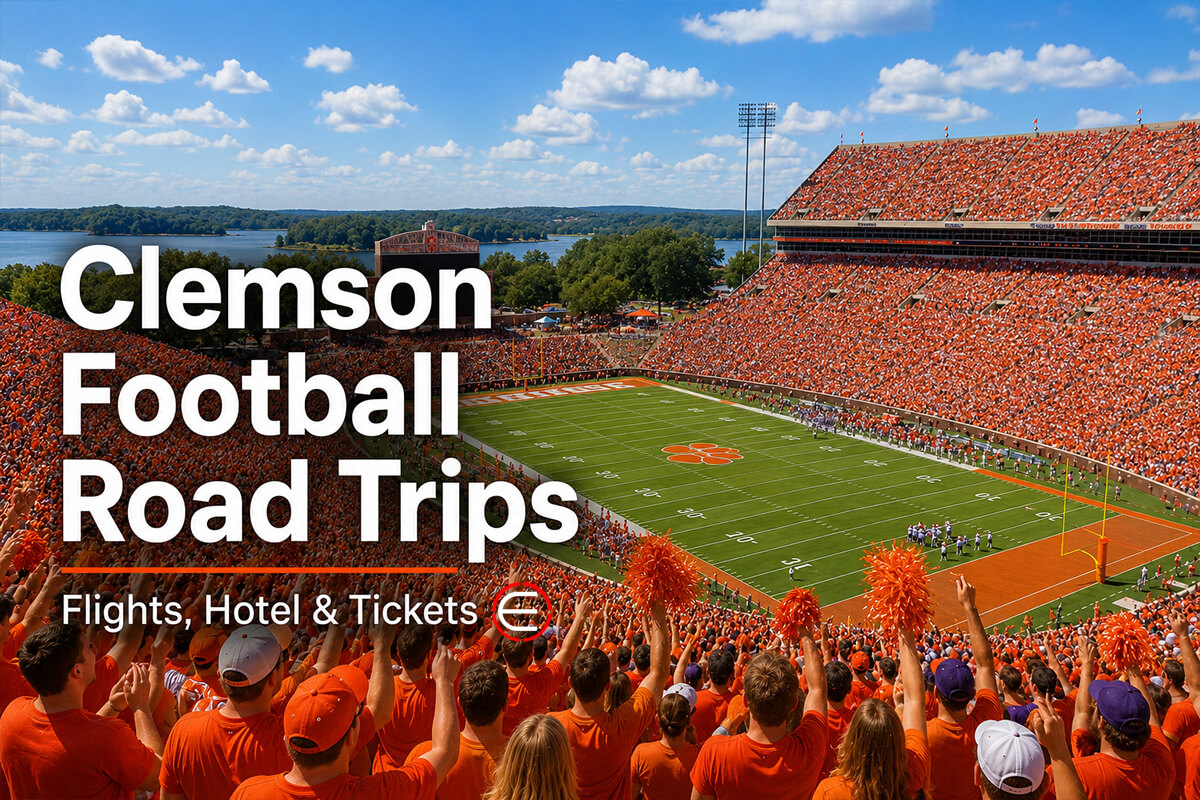
Clemson Tigers Football Travel Guide: Flights, Hotels, Tickets and Game-Day Planning
Planning a trip to see the Clemson Tigers play involves more moving parts than most first-time visitors expect. Memorial Stadium, commonly known as Death Valley, sits inside a small university town with limited hotel inventory, the nearest major airport is an hour away, and campus roads close hours before kickoff. This Clemson Tigers football travel guide covers the decisions that actually matter: which seats suit your group, where to base yourself, which airport works from your departure city, and how to move on game day.
Elite Sports Tours arranges Clemson Tigers Football Travel Packages combining flights, hotel accommodations and Clemson Tigers football tickets in one booking. Coordination matters more here than at venues with deep lodging supply, because a room chosen in isolation quietly dictates your parking plan, your postgame timing and even your Sunday flight. Kickoff times are also announced late, which makes flexible planning worth more than a cheap early booking.
What separates a smooth Clemson Tigers Saturday from a frustrating one is rarely the ticket. It is the decision made months earlier about where you sleep, how you reach campus and how early you arrive for the traditions.
Clemson Football Trip at a Glance
- Stadium: Memorial Stadium, listed capacity 81,500
- Field: Frank Howard Field
- Stadium nickname: Death Valley
- Host city: Clemson, South Carolina
- Primary airport: Greenville-Spartanburg International Airport (GSP)
- Best area to stay for most visitors: downtown, scarce rooms but a short walk
- Best area for restaurants and nightlife: College Avenue
- Best area for venue convenience: downtown and Old Greenville Highway
- Rental car normally needed: yes, unless staying within walking distance
- Best overall seating for most visitors: elevated lower-deck sideline rows
- Best value seating: upper-deck corners and end-zone sections
- Best for heat-sensitive visitors: west end zone, or covered club seating
- Best for viewing The Hill: west end zone and sideline sections facing east
- Signature pregame tradition: Tiger Walk, then Running Down The Hill
- Main planning challenge: thin hotel supply plus early campus road closures
Why a Clemson Football Weekend Is Worth the Trip
The Clemson Tigers deliver a genuinely university-centred game day, which is increasingly rare among programs of this size. Memorial Stadium sits inside the campus rather than beside a highway, so the walk to your gate passes Bowman Field, tailgates in every open lot, and a downtown Clemson strip that is a few blocks long and full of orange by mid-morning.
The pregame sequence is unusually well defined. Tiger Walk brings the team through the crowd on foot, Tiger Band parades down Fort Hill Street toward the stadium about an hour before kickoff, and the team enters at the east end by touching Howard's Rock and running down The Hill. Broadcaster Brent Musburger described that entrance as the most exciting 25 seconds in college football.
College Avenue absorbs the crowd on Friday evening and again after the game, and Lake Hartwell sits minutes from campus for anyone extending the weekend. Flight access runs through Greenville-Spartanburg International Airport, and the hour between the airport and campus shapes almost every other choice in this Clemson Tigers football travel guide.
Memorial Stadium Guide for Visiting Fans
Memorial Stadium is a steep, enclosed bowl on the Clemson University campus, with Frank Howard Field at the centre and stacked upper decks that hold noise in. Gates open two hours before kickoff, a ticket is required for every patron over the age of two, and re-entry needs a voucher collected at the gate.
Orientation is simple once you fix the ends. The east end holds The Hill, the grassy bank the team runs down, with Howard's Rock at the top and student seating around it. The WestZone encloses the west end with the main video board, most premium space and the Scroll of Honor nearby.
Weather shapes the visit more than architecture does. Early-season kickoffs run hot and humid, and afternoon thunderstorms are a real possibility. Cool Zones operate at both ends of the upper deck, misting fans run in the lower deck, one clear unopened water bottle may be carried in, and umbrellas are prohibited.
Renovation work has been substantial in recent years. A phased project added premium club space and covered chairback seating in the west end, expanded accessible seating, installed a large new video board, and rebuilt team areas and the Rogers Family Lot that now hosts Tiger Walk. That work is complete, though the athletics department has signalled interest in further enhancements, so confirm the current stadium map before travelling.
Best Seats at Clemson Tigers Football Games
For most visiting fans the best seats at Clemson Memorial Stadium are elevated lower-deck sideline rows, high enough to clear the benches but low enough to feel the noise. They give the strongest view of Frank Howard Field and a clear look east toward The Hill. The trade-off is that nearly all general seating is bench without backs.
Understanding the Memorial Stadium Seating Layout
Sections are lettered rather than numbered. Lower-deck sections carry a single letter, the upper bowl adds a leading U, the highest tier uses a TD prefix, and the numbered club sections sit in the west end zone. Elevation matters more than the letter, because the lowest sideline rows sit below the sightline that clears the benches.
The bowl is closed at both ends but very different end to end. The east end is dominated by The Hill and the student sections around it, while the WestZone encloses the west end with premium clubs, covered chairbacks and the main video board. Corners bridge the two and price below the sidelines.
Best Lower-Deck Sideline Seats
Lower-deck sideline seats between the 25-yard lines give the best overall view, and the middle third of the rows is the target rather than the front. Very low rows sit below field-level sightlines, where sideline personnel block much of the far side. Goal-line seats cost less and read formations cleanly.
Best Upper-Deck Seats
The upper decks give the best tactical view and the lowest prices, and they sit close enough over the field that the game never feels remote. The trade-off is vertical: climbs are long, the top deck is exposed, and exits move slowly. Cool Zones operate at both ends.
Best End-Zone and Corner Seats
End-zone and corner seats are the value play, and elevated corner rows are the sweet spot because they restore the angle that flat end-zone seating loses. Depth perception at the far end is the drawback. The west end looks back at The Hill and the team entrance; the east end places you beside the students.
Best Seats for Howard's Rock and Running Down The Hill
The Hill is the grassy bank at the east end, with Howard's Rock mounted at the top. Players touch the rock and sprint down before kickoff, and the strongest direct view comes from the west end zone and sideline sections angled toward that corner, because you face the entrance rather than sit beneath it.
Seats immediately beside The Hill put you closest to the players but not in the best position to watch, since the crowd stands and the angle is severe. General access to Howard's Rock is not part of the visitor experience.
Best Seats for Clemson Game-Day Atmosphere
Atmosphere concentrates at the east end, where the student allocation surrounds The Hill. Sitting in or beside that area delivers the loudest crowd involvement and the best view of Tiger Band, at the cost of standing for long stretches. The Alma Mater Salute afterwards is worth staying for.
Premium, Club and Hospitality Seating
Premium space is concentrated in the west end and along the suite levels: the Lewis and Marie Miller Family WestZone Club, the Masters Club, the WestZone covered chairbacks, the Younts South Club, the 1934 Club and the North and South Suites, all combining open-air chairback seats with climate-controlled lounges, private restrooms and food and beverage service.
Access is the complication. These areas are tied to IPTAY annual giving levels and, in most cases, capital pledges, and suites have run sold out with a wait list. Single-game availability should be confirmed rather than assumed, but for heat-sensitive travellers this is the most comfortable option.
Expert Tip: Almost all general seating is bench without backs, and soft-sided seatbacks are permitted only if they have no arms and are no wider than a single seat. Pack a compliant one rather than assuming rentals exist at the gate, because anything rigid or armed is turned away at security.
Sun, Shade and Weather Considerations
The stadium sits on a roughly east-west axis, so sideline sections stay sunny for most of the day and the west end is the only area with reliable shade, and only later on. Evening games are far more comfortable in September, while November brings a sharp drop after sunset.
Best Value Seats
Value depends on who is travelling.
- First-time visitors: west end zone or west-leaning corners, facing the team entrance
- Families: lower-deck corners away from the student end
- Budget-conscious travellers: upper-deck corners and end zones
- Older travellers avoiding stairs: low rows off a level concourse
- Fans prioritizing atmosphere: lower deck at the east end
- Fans prioritizing the football view: elevated lower-deck sideline rows
- Heat-sensitive visitors: west end zone or covered club seating
- Chairback seating: the WestZone covered sections
Seats to Consider Carefully
Several areas disappoint people who booked on price alone. The lowest sideline rows sit below the useful sightline, the highest top-deck rows mean a long climb, and low end-zone rows flatten the field badly. Seats inside the student allocation suit neither families nor anyone unwilling to stand for four hours.
Pairing a seating category with the right hotel and flight timing is where a Clemson Tigers weekend works or does not, which is why this Clemson Tigers football travel guide treats them together. Coordinated Clemson Tigers Tickets and Hotel Packages remove the guesswork of buying each piece separately.
Buying Clemson Tigers Football Tickets
Demand is driven mainly by opponent, and the gap between a marquee visitor and a non-conference opener is large. Florida State, Miami, Notre Dame when scheduled, and high-profile non-conference opponents reshape hotel pricing and flight availability across the Upstate. Homecoming adds campus events on top of the crowd.
Scheduling realities matter before anyone books. South Carolina is the primary in-state rivalry, played for the Palmetto Bowl, and it alternates between Clemson and Columbia, so it reaches Memorial Stadium only in the years the Tigers host. Florida State is the protected annual conference matchup under the current Atlantic Coast Conference model, but the host site alternates. The NC State meeting is the Textile Bowl and Georgia Tech is a long-standing opponent, yet neither should be assumed to appear every season, and Georgia is a historic rival that now appears only when the schools arrange a series.
Seat category is the other lever. Premium and club areas change a budget materially, student sections are not sold to visitors, and larger groups often accept split blocks or move to the corners and upper deck to sit together. Ticketing is mobile through the university's ticketing partner, so load tickets to a digital wallet before leaving the hotel.
Because lodging supply around campus is limited, ticket and hotel decisions belong in the same conversation, and flights should be priced at the same time. Choosing a marquee opponent without checking room availability is the most common way a Clemson trip becomes expensive. Clemson Tigers football travel packages exist to surface those constraints before money is committed.
Best Hotels Near Memorial Stadium
Clemson has a handful of genuinely walkable hotels and very little else inside the town limits, which pushes most visitors toward Seneca, Anderson or Greenville. Choosing among the best hotels near Memorial Stadium is a compromise between walkability and availability.
Hotels Within Walking Distance of Memorial Stadium
Practical pedestrian access comes down to a short list. The Abernathy on Old Greenville Highway is the closest full-service option, roughly a ten to fifteen minute walk to the stadium side of campus, with suite-style rooms suiting families and small groups. The Shepherd Hotel on Sloan Street adds College Avenue at the door, and both sell out early.
Hotels in Downtown Clemson and Near College Avenue
Downtown Clemson is the strongest base for visitors who want restaurants, bars and Friday-evening activity beside campus, with The Shepherd Hotel the anchor. Friday night is busy and noise carries, which suits couples more than families with early sleepers. Proximity to downtown is not proximity to every gate, since your entrance may still be a fifteen-minute walk through crowds.
Hotels Near Clemson University and Lake Hartwell
Clemson University's James F. Martin Inn sits on the Madren Conference Center grounds beside the Walker Course and Lake Hartwell, about a mile south of the stadium. The setting is quiet, rooms are larger than the town average and on-site dining helps, but the walk is long and exposed in September heat. Lakeside Lodge Clemson, across the water toward Seneca, suits families who want lake access and accept driving in.
Hotels in Central and Seneca
The US Route 123 corridor between Clemson, Central and Seneca carries most of the area's chain inventory: Tru by Hilton Seneca Clemson, Hampton Inn and Suites Seneca-Clemson Area and Fairfield by Marriott Seneca Clemson Univ Area, with Comfort Inn and Suites Clemson, Holiday Inn Express and Suites Clemson and Hampton Inn Clemson-University Area closer in on Tiger Boulevard. This is the best mix of price, availability and drive time, and it pairs neatly with the free park-and-ride. The trade-off is a car and a slow approach on game morning.
Expert Tip: If your group is weighing a downtown room at a premium against a Seneca room at a discount, price the gap against two game-day rideshares plus parking and the extra hour spent in traffic. For a couple staying two nights the downtown room usually wins outright; for a family of four with a rental car already booked, the Route 123 corridor almost always wins.
Hotels in Anderson
Anderson is the strongest overflow base, roughly half an hour south-east with Interstate 85 access and deeper inventory including Hampton Inn Anderson and Holiday Inn Express and Suites Anderson. Group availability beats anything nearer campus. Morning kickoffs are the weak point, because you arrive with the crowd rather than ahead of it.
Hotels in Easley and Pickens County
Easley is a secondary option on the Greenville side, with Hampton Inn Easley among the more dependable properties. It works when Clemson, Seneca and Anderson are full. The limitation is distance combined with a route that funnels into the same congested approaches, so it suits later kickoffs better than noon starts.
Hotels in Downtown Greenville
Downtown Greenville is a city-weekend strategy rather than a stadium base. Falls Park, Main Street restaurants and properties such as Hampton Inn and Suites Greenville-Downtown-RiverPlace, Embassy Suites by Hilton Greenville Downtown Riverplace, Hyatt Place Greenville Downtown and Courtyard by Marriott Greenville Downtown give the weekend a second dimension. The cost is about an hour each way plus game-day traffic, which makes early kickoffs difficult.
Hotels Near Greenville-Spartanburg International Airport
Airport-area lodging solves one problem: an early Sunday departure. Properties near Greenville-Spartanburg International Airport sit minutes from the terminal and the interstate, removing the risk of a pre-dawn drive. Walkable dining is limited and there is no game-day atmosphere, so use it as a final night rather than the base for the trip.
Alternative Places to Stay Near Clemson
When rooms in town are gone, the alternatives rank predictably. Seneca and Central are the best overall substitute and the closest source of wider inventory. Anderson follows as the best price and availability combination for families and groups. Downtown Greenville is best for nightlife and attractions, the airport area for an early Sunday departure, and Easley or Pendleton only when everything nearer is sold out. All require a rental car, and none is served by a shuttle to the gates.
How to Choose the Right Clemson Football Hotel
Match the hotel to the trip you actually want. Travellers who want to walk should pay the downtown premium and book first. Families and groups needing multiple rooms do better on the Route 123 corridor or in Anderson. Older travellers benefit from minimizing walking and stairs, which usually means driving to a park-and-ride and taking the shuttle. Anyone with an early Sunday flight should consider the last night nearer the airport, and Palmetto Bowl or marquee conference weekends bring minimum stays and much earlier sell-outs.
Hotel location sets your parking plan, postgame timing, heat exposure and Sunday departure, so it belongs alongside tickets and flights rather than after them. Elite Sports Tours builds Clemson Football Travel Packages around those connections.
Flights for a Clemson Tigers Football Weekend
Greenville-Spartanburg International Airport (GSP) is the practical choice for almost every visitor, offering the shortest ground transfer to Clemson at roughly an hour by road. Charlotte and Atlanta open wider nonstop and international options, but each adds two hours or more of driving.
Primary Airport: Greenville-Spartanburg International Airport
Greenville-Spartanburg International Airport sits between Greenville and Spartanburg near Interstate 85, with domestic service from the major United States carriers, connections through the large hubs, and rental cars, rideshare and private transfers on site. Friday arrivals beat Saturday ones, since a delayed flight can cost you Tiger Walk.
Airports Not Suitable for Most Commercial Travellers
Oconee County Regional Airport (CEU) sits close to Clemson but is a general aviation field rather than a scheduled commercial airport, relevant only to private and charter flying. It should not be searched as an arrival option for a normal football trip.
Alternative Airports
Charlotte Douglas International Airport (CLT) is the strongest alternative for international and Canadian travellers because of its nonstop breadth, at the cost of roughly two and a half hours of driving. Hartsfield-Jackson Atlanta International Airport (ATL) offers similar range with a comparable drive. Asheville Regional Airport (AVL) is closer but thinner on service, and Columbia Metropolitan Airport (CAE) rarely makes sense.
Purpose decides the choice. Greenville-Spartanburg is best for most travellers, for the shortest transfer and for an early Sunday departure. Charlotte is best for Canadian and international connectivity, with Atlanta the next alternative. A modestly higher fare into Greenville-Spartanburg usually pays for itself once a rental car, fuel and five hours of round-trip driving are counted, and Clemson Tigers football travel packages can be built around whichever airport your departure city serves well.
Expert Tip: If your return flight leaves before mid-morning on Sunday, price a Saturday-night move to an airport-area hotel rather than a dark drive across the Upstate after a late finish. On night-game weekends this single change removes the most stressful hour of the trip.
How to Get to Clemson Tigers Games at Memorial Stadium
Most visitors reach the stadium in one of three ways: driving to a general-public campus lot, parking free at a remote lot and riding a shuttle, or walking in from a downtown Clemson hotel. Parking rules supersede normal campus regulations twelve hours before kickoff, and lots open at 6 a.m. for early games or 8 a.m. for later ones.
Getting to Clemson from the Airport
From Greenville-Spartanburg International Airport the drive runs about an hour via Interstate 85 and US Route 123, with rental cars and rideshare at the terminal. Charlotte adds roughly two and a half hours and Atlanta about the same, both making a rental car close to mandatory. Reaching town is easy; reaching the stadium is the harder half.
Driving to Memorial Stadium
Interstate 85 is the spine, with US Route 123 the approach from Greenville and Seneca, US Route 76 from Anderson, and South Carolina Highways 93 and 28 carrying local traffic. Close in, College Avenue, Perimeter Road and Cherry Road matter most, and several close or reverse under traffic control. Mapping applications route drivers into barricaded streets, so check the published plans first.
Parking Near Memorial Stadium
Parking closest to the stadium is reserved. IPTAY donor placards control the surrounding lots, highway patrol officers manage entry, and ordinary weekday campus permits do not apply on football Saturdays. Most visiting fans choose among single-game public lots, city garages downtown and the free remote lots.
By need: remote park-and-ride suits visitors staying out of town and anyone wanting a predictable exit; downtown garages suit those paying for a short walk; free gravel areas such as Kite Hill suit drivers accepting a longer walk and no shuttle. Accessible parking operates separately, and towing begins the night before.
Seneca Creek Meadows Parking and Shuttle
Seneca Creek Meadows is the main free general-public park-and-ride, with bus service from the time lots open until roughly two hours after the game.
- Drive to Seneca Creek Meadows off the Route 123 corridor and park free.
- Board the shuttle, which runs continuously rather than on a timetable.
- Ride to the drop-off at Doug Kingsmore Stadium, the baseball venue on campus.
- Walk the short remaining distance to your assigned gate.
- Return to the same area afterwards and expect a queue after the whistle.
Capacity and timing are the limitations: the lot fills early for high-demand games and postgame lines are long. Confirm current hours and the drop-off point, since both have changed between seasons.
Clemson Area Transit on Football Game Days
Clemson Area Transit operates its Red Route on home football Saturdays, fare-free. Road closures shift pickups and drop-offs to Cherry Road and Bryan Circle. Buses are accessible, but weekday stops do not apply and postgame waits are long.
Tiger Transit and Campus Shuttles
Tiger Transit is the university's own campus service, not a public stadium shuttle. On football weekends it runs a limited No Tows Route intended mainly to help students and permit holders move vehicles out of game-day lots, with windows on Friday evening and Sunday afternoon. Visitors should plan around the remote shuttles or walking.
Accessible Parking and Shuttle Service
Accessible game-day parking operates from designated areas near Sikes Hall and along Parkway Drive, entered off Highway 93 at Calhoun Drive, and requires a state-issued placard or plate. Shuttle service runs from roughly three hours before kickoff until an hour after the game, limited to the patron plus one assistant.
Golf cart shuttles circulate through the athletic district from about four hours before kickoff, dropping guests at their assigned gate, with pickup points marked by tall white and blue poles. Gates 1, 5, 6 and 13 serve guests needing accessibility assistance.
Rideshare and Taxi Planning
Rideshare works reasonably before the game and poorly immediately after. Closed streets mean drivers cannot reach the stadium, so pickup happens at the edge of the closure zone, and network congestion can make the app unreliable. Walk ten to fifteen minutes away before requesting a ride, and agree on a meeting point before you scan in.
Walking to Memorial Stadium
Walking is the best approach from downtown Clemson, a campus-area hotel or the shuttle drop-off, running roughly fifteen minutes from College Avenue. Terrain is the wrinkle, since campus rolls and several approaches climb, and September heat and humidity make a short walk feel considerably longer.
Cycling and Alternative Transportation
Cycling is realistic for visitors staying within a mile or two, and bicycle racks are distributed across campus. Shared scooters face rules and geofencing that tighten during large events. Neither is sensible in the crowd near the gates, so treat cycling as a Friday and Sunday tool.
Accessible Transportation and Mobility Planning
Plan around three fixed points: accessible parking with its dedicated shuttle, the gate recommended for your seating area, and the distance and elevation between them. Designated accessible seating exists in both the east and west stands, and extra time is needed in both directions.
Leaving Memorial Stadium After the Game
The fastest departures belong to people who walked. Pedestrian congestion clears within twenty to thirty minutes, while lots release in stages and some routes reverse direction. Shuttle riders should head for the buses promptly or wait deliberately, and rideshare users should walk out of the closure zone first. Travellers bound for Seneca, Anderson, Greenville or the airport face the slowest exit, and drives toward Charlotte or Atlanta should not begin after a night kickoff. Clemson Tigers football travel packages avoid crossing that zone twice in a day.
Tailgating and Clemson Game-Day Experience
Game day is built around campus tailgates and a tightly scheduled pregame sequence. IPTAY placards control the lots closest to the stadium, tailgate setups must fit within the marked space, and open areas across campus fill with tents from early morning. Downtown Clemson and College Avenue carry the overflow, and Bowman Field is the heart of campus activity. Public space is limited compared with the reserved lots, so visitors without a placard usually gather downtown or at a remote lot before riding in.
Tiger Walk begins at the Rogers Family Lot about two hours and fifteen minutes before kickoff, when the team walks through the crowd toward the stadium. Tiger Band greets the team, plays a short concert on campus and then parades down Fort Hill Street roughly an hour before kickoff. Both are free and open to anyone on campus, though a ticket is required to enter Memorial Stadium itself. Confirm current timings, since they shift with kickoff.
A few practical points help. Orange is close to universal, though visiting colours are worn without difficulty. Tickets are mobile and data near the crowd is patchy. The campus is tobacco free, umbrellas and backpacks are prohibited, and the clear bag policy is enforced at every gate. Hydration is not optional in September, and thunderstorms can suspend play, so know where you would shelter. Alcohol is sold inside with service ending after the third quarter, and nothing bought outside may be carried in. Confirm current rules before travelling.
Clemson Tigers Football Traditions
Clemson's traditions cluster tightly around the two hours before kickoff, so arrival time decides how much you actually see. A visitor who reaches the gates forty-five minutes out will catch the crowd but miss most of what makes the day distinctive.
Howard's Rock, a white flint stone given to coach Frank Howard and mounted at the top of The Hill, is touched by players before every home game. Running Down The Hill follows, with the team entering the east end to Tiger Rag and a cannon shot. Tiger Walk brings the team through fans beforehand, and Tiger Band performs on campus and parades to the stadium. After the game, the Alma Mater Salute sends fans into the familiar raised-hand gesture, and supporters often gather on the field once teams and officials have cleared. Solid Orange Fridays, the First Friday Parade before the season's first home game, and Homecoming with Tigerama and the Bowman Field displays round out the calendar. Fans also carry two-dollar bills stamped with a tiger paw to away games, a habit dating to the 1970s.
Biggest Clemson Tigers Rivalry Games
The rivalry that matters most to South Carolina travellers is not guaranteed to be in Clemson. The Palmetto Bowl against the South Carolina Gamecocks alternates between Memorial Stadium and Columbia, so it lands in Clemson only in the years the Tigers host, and those weekends are the hardest of the year to book.
Florida State is the protected annual conference matchup under the current Atlantic Coast Conference scheduling model, with the host site alternating. The NC State meeting carries the Textile Bowl name and Georgia Tech is a long-standing opponent, but neither is currently guaranteed every season, so check the published schedule rather than assuming. Georgia and Georgia Tech are historic rivals whose appearances now depend on scheduling agreements, and Miami, Louisville and Notre Dame produce comparable travel demand when they visit without being traditional rivalries.
Practically, these weekends compress hotel availability across Clemson, Seneca and Anderson, push airfares up, thin rental car supply, trigger minimum stays and make group seating harder to secure in one block. Booking timelines move forward by months rather than weeks, and group seating is the first thing to disappear.
Things to Do in Clemson
Clemson offers enough for a genuine weekend without competing with the football, and most of it sits within a short walk or drive of campus. The town is small, which is an advantage: nothing on this list requires a long detour, and Sunday morning is usually quiet enough to enjoy it properly before an afternoon flight.
Friday suits arrival, a walk across Bowman Field past Tillman Hall and Sikes Hall, and dinner on College Avenue, where independent restaurants and breweries cluster within a few blocks. Fort Hill, the historic house at the centre of campus, is worth an hour when open. Saturday morning belongs to the tailgates. Sunday works well for the South Carolina Botanical Garden and the Bob Campbell Geology Museum on the edge of campus, or for Lake Hartwell and the trails of the Clemson Experimental Forest if the weather cooperates. Nearby Pendleton and Seneca offer quieter small-town lunches, and downtown Greenville pairs naturally with a late airport departure. Confirm current public hours before planning around any of them, since campus buildings and museums keep seasonal schedules.
Sample Clemson Football Weekend Itinerary
The pattern below assumes a Friday arrival and Sunday departure, the structure most Clemson Tigers football travel packages follow.
Friday: Arrival and Orientation
Land at Greenville-Spartanburg International Airport in the early afternoon and collect a rental car or private transfer. Check in, then head into downtown Clemson for dinner on College Avenue. Use the evening to trace your game-day route, locate your parking area or shuttle pickup, and confirm the closure map.
Saturday: Game Day
Eat a real breakfast, because the day runs long. Be on campus about three hours before kickoff to see the tailgates and Bowman Field, then position yourself for Tiger Walk roughly two and a quarter hours out and the band parade about an hour before the game. Enter the stadium at least forty-five minutes early so you are seated for Running Down The Hill, remembering that re-entry needs a voucher. Afterwards, walk into downtown and let traffic thin, or move promptly to your shuttle or vehicle.
Sunday: Departure
Take a slower morning, have brunch downtown and add the botanical garden if your flight is late enough. Allow an hour and a half to the airport including the rental car return.
Adjust for kickoff. A noon game means a very early alarm and strengthens the case for staying in town, an afternoon game is the easiest version, and a night game usually justifies an extra hotel night. In early-season heat, plan indoor time midday; in November, pack layers for a sharp evening drop.
Planning a High-Demand Clemson Football Weekend
Marquee visitors, homecoming and night games push planning in the same direction: book earlier with less flexibility. For a South Carolina, Florida State, NC State, Georgia, Miami or Notre Dame weekend with the Clemson Tigers, treat six to nine months ahead as normal rather than cautious. None of those opponents is hosted at Memorial Stadium every season, so confirm the location before booking anything.
Expect two-night minimum stays across Clemson and Seneca, higher fares into Greenville-Spartanburg, and rental car inventory thinning first in the categories families need. Visiting-team allocations are finite and placed in specific areas, so groups wanting to sit together should fix a seating category early rather than optimizing on price alone. Parking and shuttle capacity feel tighter, heat matters more when a marquee game lands in an afternoon window, and late finishes push travellers into an extra night and a later Sunday flight. Clemson football weekend packages and Clemson Tigers football travel packages are easiest to secure well before demand peaks, and adding a Sunday night is often cheaper than rebooking flights later.
Clemson Tigers Flights, Hotel and Ticket Packages
Elite Sports Tours coordinates Clemson Tigers football travel packages around the pieces that interact: flights from your departure city, the airport that suits your routing, the hotel area matching your game-day plan, the number of nights the kickoff time requires, room configuration, ground transportation and a seating category chosen for the right reasons. That is the practical value of Clemson flight, hotel and ticket packages over assembling a trip piece by piece, and the point of this Clemson Tigers football travel guide.
The cheapest combination is rarely the best. A downtown Clemson room removes the game-day drive but sells out first and carries a premium. A campus-area property improves stadium access with very limited inventory. A Seneca or Central hotel adds rooms and pairs well with the free park-and-ride, at the cost of driving. Anderson broadens availability and lengthens the commute, Greenville improves dining while committing you to an hour each way, and an airport hotel solves an early departure while adding nothing to the atmosphere.
Airport choice behaves the same way. Greenville-Spartanburg International Airport shortens the ground transfer to about an hour, while Charlotte and Atlanta open different flight options at the cost of a long drive, and an early Sunday flight can justify moving hotels for the final night. Visitors who most want to see Running Down The Hill should prioritize a different part of the bowl from those chasing the best midfield view, heat-sensitive travellers often get better value from covered seating, premium seating changes a budget materially, a night game frequently justifies an extra night, and groups need coordinated seating and multiple rooms secured together. Clemson Tigers football travel packages hold those variables in one place.
Elite Sports Tours is an independent sports travel company, not an official partner of the Clemson Tigers, Clemson University, the Atlantic Coast Conference or the NCAA, and availability depends on the market at booking. What the company provides is one plan covering tickets, hotel accommodations, flights and the logistics connecting them, on Clemson football trips and college football travel packages elsewhere.
Explore Clemson Tigers Football Travel Packages
Frequently Asked Questions
What is the best airport for a Clemson Tigers football game?
Greenville-Spartanburg International Airport (GSP), about an hour from campus.
What is the closest commercial airport to Clemson?
Greenville-Spartanburg International Airport. No airline serves Clemson.
Is Oconee County Regional Airport a commercial airport?
No. Oconee County Regional Airport (CEU) handles private and charter flying.
Where should visitors stay for a Clemson football weekend?
Downtown Clemson if available. Seneca and Anderson hold more inventory.
Can you walk from downtown Clemson to Memorial Stadium?
Yes, about fifteen minutes from College Avenue.
What are the best seats at Clemson Memorial Stadium?
Elevated lower-deck sideline rows.
Which seats provide the best view of The Hill?
The west end zone and sidelines facing the east entrance.
Which seats provide the most shade at Memorial Stadium?
The west end zone, later in the day.
Do visitors need a rental car in Clemson?
Most do, unless staying within walking distance of campus.
Where can visitors park for Clemson football games?
Lots around the stadium are reserved for IPTAY donors, so most visitors use free remote lots.
How does the Seneca Creek Meadows shuttle work?
Park free and ride a continuous shuttle to Doug Kingsmore Stadium.
Does Clemson Area Transit operate on football game days?
Yes. The Red Route runs fare-free, with pickups on Cherry Road and Bryan Circle.
What is Howard's Rock?
A white flint stone at the top of The Hill, touched by players pregame.
What is Running Down The Hill?
The team's sprint down the grassy bank at the east end.
What is Clemson Tiger Walk?
The team's walk through fans from the Rogers Family Lot, roughly two hours out.
How early should visitors arrive at Memorial Stadium?
Around three hours out; gates open two hours before kickoff.
Is a Clemson football weekend suitable for families?
Yes, though avoid the student end and plan around the heat.
When should travellers book Clemson football packages?
Six to nine months ahead for marquee opponents, three to four months otherwise.
Is Clemson's Death Valley the same stadium as LSU's Death Valley?
No. Clemson's Memorial Stadium and LSU's Tiger Stadium share the nickname, so use official names when booking.
Editorial Note
Elite Sports Tours produced this Clemson Tigers football travel guide to help fans plan complete trips involving flights, hotel accommodations, tickets, stadium access, seating and game-day logistics. Recommendations reflect research into official university, athletics, venue, municipal, transit and airport information.
Travel Information Disclaimer
Stadium policies, entry procedures, bag rules, parking programs, IPTAY arrangements, shuttle operations, transit routes, road closures, tailgating rules, accessibility arrangements, hotel availability, flight schedules and ticket availability all change, and further renovation work may alter gates, seating and pedestrian routes. Confirm current information with the relevant official source before departure.